Thursday, 6 September 2012

The friendly Leicester Sound

Bros were really keen to see themselves on 'Pebble Mill at One'.  It was to be the boyband's first TV performance and they didn't want to miss it just because they were on the road doing a radio interview.  All very well, but, sadly, Leicester Sound did not have a TV set.  I ran back to my flat nearby to grab a heavy portable set; and returned breathlessly just in time to twist the wire aerial to get a fuzzy picture of their three young, smiling faces. 

Just another lively day in the rich life of Leicester Sound.  The station was always going to be a challenge. It rose from the detritus of Centre Radio, the first commercial radio ‘failure’ which closed abruptly after just two years, amidst financial difficulties.  When neighouring Radio Trent’s offer to keep Centre on life-support was turned down, the station died and its legacy handed over to the liquidators.  The hopes of Trent’s immediate rescue had been sufficiently high for a package of jingles to be recorded hurriedly at Alfasound.

Process kicked in; and the then regulator, the IBA, re-advertised the Leicester franchise. 
Trent, meanwhile, bought the premises, thinking it would either launch the station at a later stage under its new franchise; or sell it on to a rival franchise-winner.  It was a nice asset – an 1876 stately home on the edge of Victoria Park, boasting stained glass windows, beautiful stone fireplaces and an underground cavern equipped with a generator large enough to power Loughborough.

Norman, Ron & Chris
Leicester Sound was awarded the franchise, one of the first times ever the IBA had awarded a second franchise to a related company.  The Trent management team, headed by Ron Coles as MD, with Chris Hughes as programme director and Norman Mabe in the sales director's chair, prepared to gear the business back into action.

I recall travelling to Leicester just after the decision, armed
with the Granville House keys for a Marie Celeste moment.  Anoraks will appreciate what it’s like to click on the light switch in a studio which had fallen silent abruptly one year before.  A half-empty plastic coffee-cup; the final weather forecast; and a defiant red biro doodle lying on the black, scratched MBI mixing desk.

The Leicester on-air team was recruited by the Trent programming management: Nick Murden; Guy Morris; Tony Lyman; and Andy Marriott, all poised to broadcast live for 12 hours a day.  Graham Neale’s rock show, specialist music programmes and the late show with Erica Hughes or Chris Burns filled the remaining hours, piped from Nottingham.  They resided in the roomy presenters' office, replete with coving, which was typically an atrocious mess, strewn with cardboard 7" single covers addressed to ex-jocks and decorated just by a model of Thunderbird 2 dangling from the high ceiling adjacent to Marrow's desk.  

Marrow claimed he sensed a ghost on the stairs next to the the beautiful stained glass windows.  Not only a radio station, it was said, had died tragically in this lovely building.  

The newsroom was housed across the corridor in a draughty conservatory, with the compulsory aged car stickers peeling off the cracked window panes. Newsroom staff through the years included great voices like Julie Langtry-Langton (now with BBC Leeds); Jackie Leonard (BBC World Service); and Sybil Ruscoe (later Radio 1 and 2).  Character was supplied by the likes of the gentlemanly news editor, Peter Butler. Meanwhile, talented sports journalist, Keith Daniel would hammer out the sports scripts on a battered typewriter, whilst the religious team, Ian and Suzanne would bicker in the corner.

Guy Morris
On September 1984, the station launched and, at last, those Alfasound jingles were belatedly aired from their blue AA3 carts with pretty labels.  My only duties back then were assisting from afar at  Trent, making many of the Leicester promos, by invitation. My earnest efforts with copying, vari-speeding and phasing on 10.5 inch spools was not called 'imaging' back then.

The station launched cautiously, as suggested by its geometric logo, in corporation green set in anemic caramel. That was best displayed on the radio car, a lop-sided, converted Cortina with questionable suspension and a retractable mast as high as Droitwich.  The vehicle and the studios overall were duly maintained by the station's committed engineers Bob, Denis or Pete, who lived in the station's engineering workshop from which the delicious smell of flux would waft.

My dad once said that if you can sell something in Leicester, you can sell it anywhere.  These were testing times still for commercial radio generally, and Centre’s failure did not help the determined souls selling airtime spots.  Leicester Sound boasted a characterful team, including the woman who once threw a glass of wine over me. 

The commercial team was headed by moustached Tim Rogers in the early days, then Barrie in his suave grey suit. Both sought to climb the necessary hill to persuade the cynical burghers of Leicester to invest their monies in radio spots. The other option was 'co-funding': a cunning early form of sponsorship which enabled us to attach brands to certain programme features.  As it transpired, Cavendish Finance and Barry Wardle's Motorama added their name to just about anything that moved, or at least anything which had not already got a Leicester Co-Op 10" solus ad attached.  Tim also hosted the Country show on the station, back in the days when evening specialist music programmes were commonplace, and he quickly deduced correctly that if he secured a lucrative sponsorship for his own programme, it would remain on the schedule ad infinitum.

The station was always in the shadow of its big brother, Trent, which powered in as an audience and advertising competitor.   I recall it once being suggested, probably accurately, we were making more money from renting out some car parking spaces and running the Coke machine than the radio business was making.  As James Cridland will recall, for he was an early student, Leicester Sound also frantically launched a training school, where young disc jockeys were coached in which colour leader tape to use.  Under Heather Purdey's beady eye, corporate training was also on sale, and I recall sitting in the derelict Studio 4 pretending to be a police officer at the end of the line as we coached Leicestershire Constabulary on how not to proceed in a 'Northerly direction' when searching for an 'assailant'.
Chris Hughes
I cringe at memories of my arrival there as a young manager in 1987. Maturing from a brief ‘awkward jock’ phase into someone who wanted to do more, I’d been despatched to 'bleeding' Leicester Sound, as it was often dubbed at Trent, as Deputy Programme Controller.  I’d made a case that the station would benefit from more attention; so I was to be the day-to-day man on the ground.  The station’s nominal Programme Controller, Chris Hughes, wisely left me to it and his visits to the station  - and to the Happy Eater en route  - became increasingly rare.  I was poorly-equipped for the challenge ahead of handling those who were on the air when I was growing up. One learns quickly. May I apologise here for everything.

Wendy Staples and me
Anyone who talks now about Leicester Sound will smile and utter one name within the first minute of reminiscences.  Wendy.  Wendy on reception.  Every great station needs a Wendy: an individual who instinctively unites the building, whatever their title.  Despite being a highly-skilled role, it pays little and there is no interview process. Wendy was a stunning receptionist, who realised her job was to satisfy listeners, not to answer phones.  She also knew everything and everybody. She listened; and said the right things to the right people to ensure the most positive outcomes.  She defended vacillating management decisions with serial professionalism and loyalty; and supported managers less able then she was.  She both looked after 'her boys'; and told them off.  People both hugged her and cried on her shoulder. She danced to the Bee Gees as you played them; and made the sort of encouraging faces through the glass which every presenter needs to see when they are on-air.  She understood.

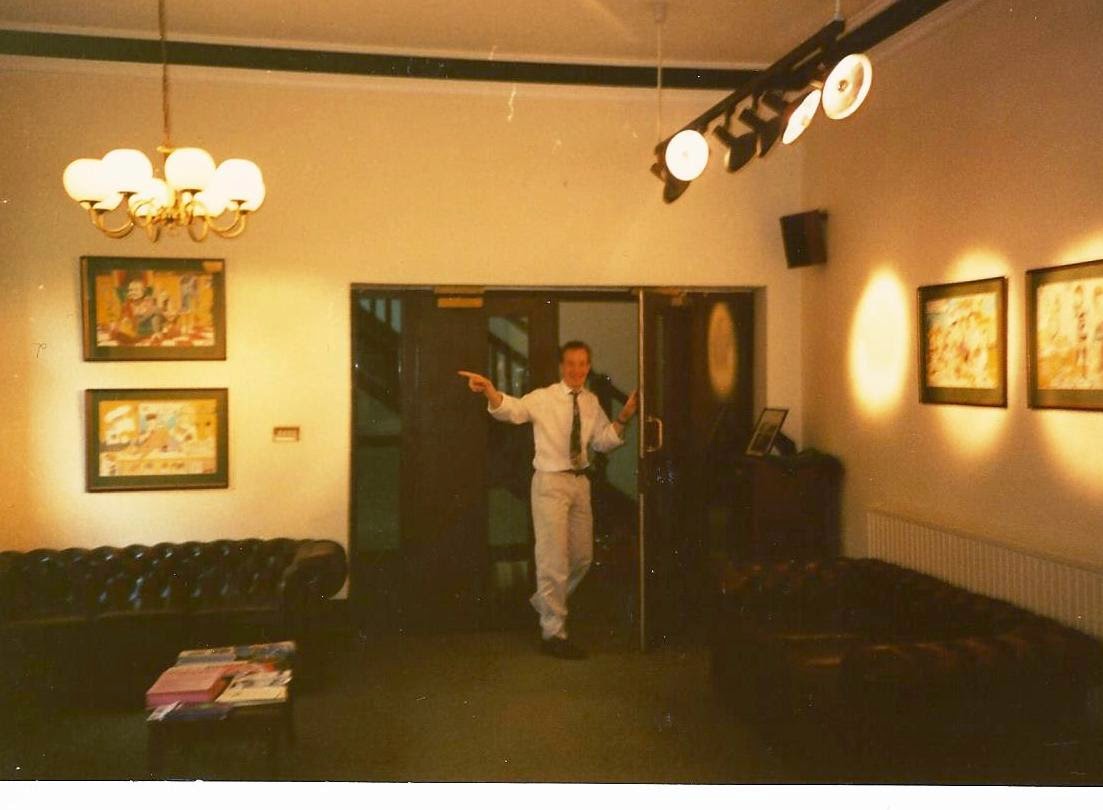
Wendy lived like a princess in the most beautiful reception ever: high ceilings, a huge fireplace and cartoons dangling from the mahogany picture rail. Large leather sofas reclined in the corners, so comfortable that one programme guest once notably fell asleep. Being just a few paces down the beautiful New Walk from town, Leicester Sound reception became a haven for all sorts of Leicester oddities who would call in for tea and sympathy and to stare into the studio or at the logging tapes go round in their glass display cupboard.  

The green baize studios were wisely locked away in what had been the stable block; really unfortunate if you popped out during a show and forgot your key. Step forward, Erica Hughes.

On-air, the station was fun. The imagination and freedom of the early '80s was evolving into a slightly more considered approach. Mind you, we still all picked our own oldies from the huge walls of vinyl in 'Bubbles Goodbody's' (Di Harris) record library, and the new CD albums we played rather depended which ones St Martin’s HiFi had lent us. Playing something 'off CD' was a major event and thoroughly trumpeted on-air.  Leicester's own, inimitable  Kenny Hague became a regular and much-loved feature of the line-up, and new talent like Wigston lad, Mark Hayman and David Manning were recruited to the ranks.  Guy Morris ploughed on, like the focused professional he is to this day, distracted only by the many calls he took for his other businesses on the studio ex-D line during his segues.  


From the outset, there was worry that we were being confused with the hugely successful, and first ever, BBC local station.  We experimented, puzzlingly in retrospect, with declaring that we were 'the commercial sound of Leicestershire' and 'after the break radio'.   Then, we discarded the element we had in common in our names: Leicester.  Hence, the name 'Sound FM' was born.  Not the greatest of names, but the thought was there.  

The station had launched on 97.1 FM, moving to the better 103.2 and then eventually in 1997 to the powerful 105.4, where only London's Melody Radio prevented it being heard in Surrey.  
The Sabras tea
Leicester Sound inherited from Centre Radio a hugely popular AM Asian programme stream, called Sabras (all tastes), run by the impressive Don Kotak. On Leicester Sound, these hugely popular evening programmes expanded into a full night-time station.  Within the building, this dedicated team became part of the station's rich character, from Didar's wonderful curries to rather large overseas phone bills.  I was called upon by the hard-working Asian commercial producer to voice ads for '30% off all saris, Belgrave Road, Leicester', which would be liberally spiced with tape echo.  Anwar worked literally through the night at busy times and was always puzzled with English work patterns: 'why do you work 9-5 when there's nothing to do, and yet go home at 5 when you're busy?'.  He had a fair point.  

Don't ask me about the Health & Safety nightmare when a Bollywood star arrived: it was like JLS popping in and I still go cold when I realise how close to catastrophe we got.  I had alerted PC Plod beforehand, who turned up when it was all over.  And there were the jingles too: I recall sitting in rainy Manchester with Alfasound vocalists, Steve and Ian, paired with a chap banging Tabla and some great Hindi vocalists, all singing in unison over 1960s PAMS tracks.  I think Len Groat was feeling in a polite mood when he heard the results.

Me on LS Airshow Radio 1494
The Careline was fun.  Wise daily words about toy appeals, venereal disease or the inter-denominational Winter tree. One never quite knew what would follow the accapella. The Careline team was a fascinating group of folk too: I recall there was once some sort of military coup amongst the troops, connected with Careline operation and management.  Whilst on-air, I had to put on my management hat half-way through a long song and dash out to the opposite pavement of London Road where rival factions were arguing angrily over who should have custody of the desks.

Kenny Hague
They invented a new title for me of 'General Manager'.  I inherited the sort of office you dream of: a heavy mahogany door with golden handles and enough room inside for a rave.  And I inherited the lovely Gill as my PA who initially frightened me, back in the days when one needed a two week course to use the new word processor. Post-It notes on Gill's door warned us not to disturb her during 'petty cash Fridays'.   

I presumed I was still also Deputy Programme Controller rather than Programme Controller, until Chris Hughes wandered into my office one day and we debated, per chance, who did what. ‘I thought you were Programme Controller’, muttered Chris. Hence I became PC.  

An early duty had been to attend to the difficult issue of the breakfast show presenter who was arriving a little late rather too often. Having been tipped off, I arrived at the crack of dawn just to witness things for myself.  As 6.00 came and went, Nick failed to arrive and I duly cranked up the station myself.  When he eventually arrived, looking more than a little crestfallen to see me in the chair, I sent him home.  Alas, Nick's life was to end prematurely, at the age of 30, a few months afterwards.  Sadly, far too many complicated radio lives end far too soon. Three of those in the launch presenters' shot at the head of this article are not around to muse on this 30th anniversary. This can be a job and an industry of enormous highs and lows. The station's first voice is remembered with huge fondness to this day by former colleagues and many listeners.

They were funny old days. Marketing departments did not exist. So, it was left to me to wait for the stage to arrive at a rainy Abbey Park and help to unroll the tent. Then, putting on silky jacket, standing on a stage for three hours talking to three men and a dog; one of whom turned up at every single event we ever did. He clutched a branded carrier bag of unknown contents.  

Like many stations, Leicester Sound boasted an impressive array of merchandising, from  the usual T shirts and mugs to branded cuddly teddy bears and a selection of boxer shorts.  Given there were male and female versions of this attractive logoed underwear, it was Wendy's job on reception to ensure that those who needed a pair with a useful opening received just that.
The station took its place in the fabric of the City, and rallied round in times of crisis. One terrible Winter, I recall a Sunday where Mark Hayman and I launched emergency programming with non-stop information on power cuts and road closures, and that double-header continued for eight hours, barging right through the Pepsi Chart.  One valiant chap parked his car just outside and slid up the path to bang on the reception door, only to ask for a wire coat hanger with which he could fashion a makeshift aerial for his car.  Back then, it seemed, you just couldn't live without radio.
Ron Coles & Miss Leic Sound!

Leicester Sound was one of the first stations in the country to put its AM and FM frequencies to different uses rather than simulcasting the entire output; and it formed one of the six stations in the IBA's 1986 experiment.  Evening Asian programming had been the first tentative venture, before AM was peeled off completely to form GEM AM in October 1988.  This was to be the UK's first completely separate 24 hour AM service.  MD Ron, wearing yellow trousers on the day, demanded that the station launch with an Olympics-inspired regional run round its three counties.  The stunt began outside Leicester Sound at the crack of dawn, with inserts live into the Leicester, Nottingham and Derby breakfast shows.  The success of Sabras, however, meant that, in time, Leicester's AM frequency, 1260 kHz was later to be pulled away from GEM to be allocated to Asian programming full time.

Times were tough in those days for a host of reasons. Eventually, in a cost-saving round, I was asked to share evening drive programmes with Trent at a time when I was ill-positioned to stamp my feet and say no. Hearing on my Leicester station that it was 'busy' on Nottingham's Maid Marian Way was annoying, to say the least, when we were seeking to carve out a reputation as 'Leicester's station'.  Those who tut at today's regionalisation easily forget the quiet economy measures of that era.  I also recall the occasion when all four Midlands Radio stations were each asked to make two redundancies.  Such a reduction cut proportionately harder in Leicester than in the mega Birmingham operation; and I cringe when I look back at implementing my first ever round of painful redundancies.  Not least as one post just saved the grand sum of £8,000.
Mike Cass

In the end, after the East and West Midlands stations merged to form the Midlands Radio Group in 1992, then one of the biggest radio groups in the UK, this was the one job that became too much. The on-air daily shows combined with the off-air programme, marketing and general management hassle, amidst the the frustration of the birth pangs of a radio group, took me to the brink.  As I drove to yet another Midlands Radio Group meeting at Mercia, I missed my turning on the ring-road and got lost in Coventry. The straw duly broke the camel’s back, and I resigned in tears on arrival.  Ron offered me a prawn sandwich to calm me down, but to no avail.  I handed back my lovely Nissan 200SX and resigned with no job to go to.

We had a lot of interesting folk through the doors of the Great House, including our fair share of work experience folk.  Dashing student, Keri Jones, now Radio Scilly supremo, quickly became an expert at packing the 'whizz box', the daily package despatched by bike to Trent.  I also recall one particularly annoying dark-haired spotty teenager who really got in the way, to the extent I suggested that Kenny Hague sent him away.  The lad returned, determined, a few months later, by which time he'd emerged into someone alarmingly indispensable. Called Mike Cass.
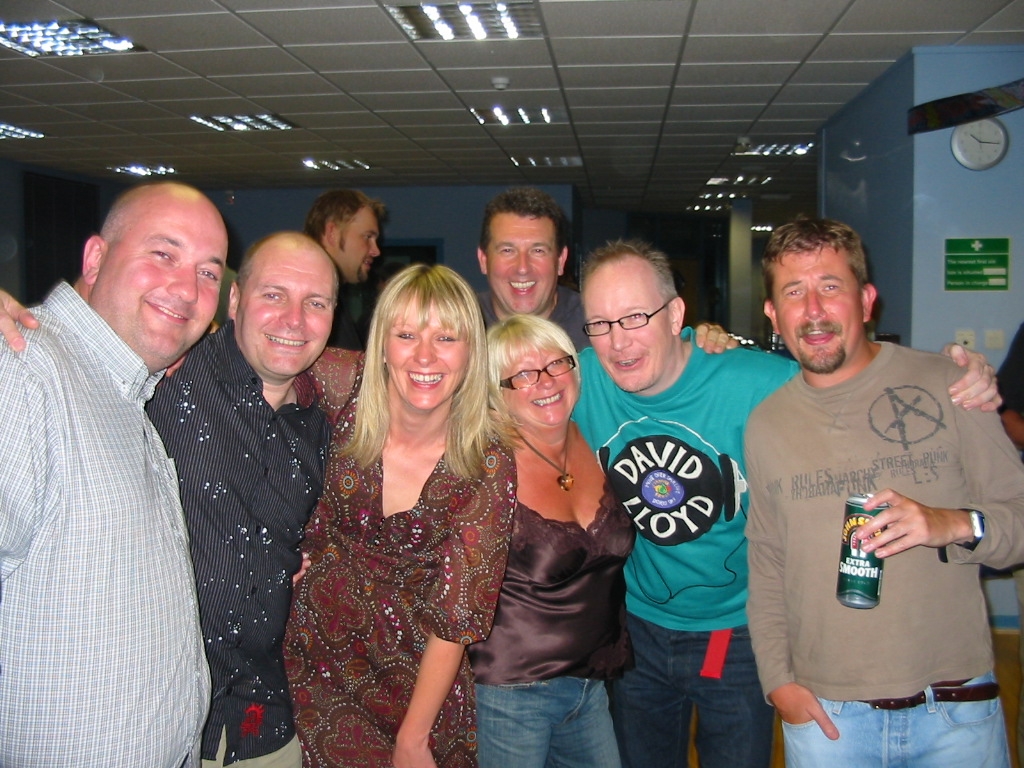
Reunion at new premises: (l-r)Tim;Paul;Di;Wendy;David;Andy. Guy (back)

So ended four years at Leicester Sound. On reflection, great memories, as for so many others.  Certainly a huge learning experience.  Every radio group has a 'challenging station' which struggles for no explicable reason, and they often push some of their best people inside it, in a valiant effort to make progress. The Leicester Sound Hall of Fame is impressive. 

I do recall the closest we got to audience success in those early days, when the company reached 40% reach overall (29% for Leicester Sound FM and 19% GEM AM/Sabras), which prompted the commissioning of a pricey celebratory spread in the Leicester Mercury.


Julie Langtry-Langton from News in Studio 2
The Leicester Sound memorial is maybe its home, Granville House: largely impractical but utterly beautiful.  Later, hurriedly converted into net-curtained flats. On a recent daytrip, as we paused to take a photo outside, the new inhabitants waved through the ‘boardroom’ window. I suspect I was not the only one who’d returned to take that same fond shot– and I guess the new residents had been treated already to tales of, well , all the above. And more.

I aspired to return to Leicester in 1994, when Lincs FM (as 'Jupiter Radio') applied for the Leicester licence upon its re-advertisement.  Few commercial radio incumbent licensees were challenged across the UK, and even fewer were displaced (LBC, Victory, Devonair). At the time of the Leicester re-advertisement, however, good old Leicester Sound did look a little sorrowful, with its FM audience figures suggesting a 25-44 adult reach of 16%, and female adult reach at 14% (Rajar Q2.93).  Notwithstanding methodology changes, Capital in the larger East Midlands TSA now enjoys a 29% 25-44 reach, in the face of two FM local competitors and reinvigorated BBC music radio on FM.  
The original Leic Sound sales team, fronted by Tim Rogers

For the Jupiter team, the application was sadly not to be successful, although I gather we were close to seizing the crown.  GWR had just assumed ownership of the station at the time from Capital (as Capital shed its Midlands acquisitions apart from BRMB in January 1994, a year after it had acquired them), and fuelled by the canny return of Ron Coles with his talented quill with which he'd penned so many successful licence applications, the new team retained the FM licence. The AM licence, which had been, by then, sub-contracted to Sunrise Radio, was given deservedly to the Sabras team which launched its own dedicated operation, on-air to this day from a fine old church building on Melton Road.

GWR was to merge with Capital to become GCap in 2005; and GCap was acquired by Global in 2008. The future could have been different had the Piccadilly acquisition of the Midlands stations, including Leicester Sound, in 1988 succeeded, or had the Radio Authority not blocked the DMG Radio acquisition of Leicester Sound alone in 1997. Or had Jupiter won.

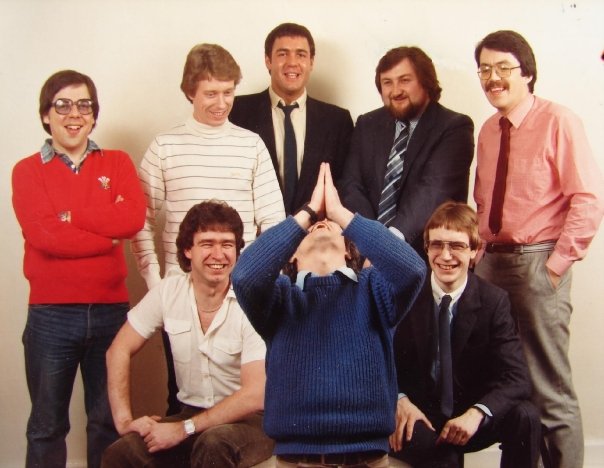
Launch on-air team
Andy, Guy, Nick & Tony
Leicester Sound moved from Granville House into more sensible premises on July 30th 2002, with Steve Jordan uttering the last words from the battered studios.

The station then continued until the back end of 2010, when its old name gradually faded out, ready for its 'merging' with Trent (Nottingham) and Ram (Derby) to form Capital (East Midlands) which blasted on-air from Nottingham on 3rd January 2011. The transmitters now form part of Capital Midlands.


This is an archived blog post - you can see my new blog here.


For more Leicester Sound memories - catch my book 'Radio Moments' 


Tuesday, 4 September 2012

Listeners are allowed to be awkward


Wearing a long beige coat, his face wrinkled with annoyance, he was clearly not happy we had made some changes at the radio station. So annoyed, he’d popped into reception personally to tell us off and inform us he was about to write to his MP. We were a public service and we’d let him down. By changing.

Listeners are demanding. I remember once, having introduced some major changes on a format, getting angry calls from listeners saying ‘What have you done to my radio station’. Calls tantamount to a landlord ringing his tenant in disbelief on learning the tenant has just knocked down the living room wall.  We are but temporary custodians of someone’s else’s property - their radio station. Each call started with the words: ‘I’ve been listening to station X for Y years’; I could even recite their script before they started.  Whilst temporarily distracting, the calls must actually be a comfort to us: such listeners genuinely feel we belong to them.  We are part of their lives; part of their family.

One listener some years ago once wrote to me about a presenter change.  She hated the new presenter.  She told me he had offended her 13 times so far on the day she wrote.  I pictured her, sat with a chewed HB pencil gripped in hand, crossing off another strike on the third five bar gate on her Basildon Bond notepad.  A former colleague related to me too the story of the listener who could not believe that a programme time had been changed – she had always had her Sunday bath accompanied by this show. I think he gently suggested she revise the timing of her ablutions instead. Isn’t it flattering, though, that listeners believe that the station is for them alone - as, actually, that is exactly what we suggest to every broadcaster: you are speaking to one person.  Mind you, be careful who that one listener is: I recall the tale of one brand change years ago when a listener had a coffin delivered to the station boss.  He had killed their station.

The BBC get a few concerned listeners too.  The ‘don’t take Radio 4 off Long Wave’ campaign was reputed to have that famous polite protest where the grey-haired gathered politely outside Broadcasting House to chant: "What do we want? Radio 4. Where do we want it? Long Wave; What do we say? Please”.  And Mark Damazar probably still rues the day when he thought innocently that Radio 4 listeners might prefer to wake up with a little more solid Radio 4 content, rather than a medley of sea shanties.  Don’t mention the UK Theme. Daa, da da da da daah.... Mark later conceded: "I don't regret it but I think I underestimated the fact that I was causing some people considerable pain". Considerable pain?

What of a station closure? I recall tales from my Radio Authority days of the volume of response which the regulator had received on its decision not to re-award the London talk licence to LBC. Was that more or fewer letters than its fellow regulator, the ITC, received about the demise of Thames Television?

As a friend, we are turned to.  Many presenters can cite listeners getting in touch to say: ‘you really helped me’. I cannot be the only programmer who has taken a call from a listener in real danger who reaches to their radio station for help.

Listeners can be demanding of their friend.  We had a major competition once to win a car, or a runner up holiday prize.  The two contestants duly arrived, one happy and great to be with; the second, a career competitor, who simply wanted the prize.  That’s fine, I guess.  Should we really expect participants to be sufficiently polite to realise that the fair exchange for a free competition might be to provide us with some entertaining programming?  Thankfully, quite fairly, he did not win.  As you can imagine, he took it in good spirit.  He lodged a complaint that his questions were deliberately harder.  They weren’t - tempting though it would have been.  Nor was he satisfied with the holiday prize, it was in the wrong country.  He demanded we change it as he did not want to go there.

Holiday prizes are often riddled with difficulties.  Listeners who find the stipulated dates inconvenient complain. They argue too if they want to take an extra person because they feel the excess is unreasonable and blame us.  A old colleague reminded me of a Barbados trip winner who looked to the radio station for compensation for her sunburn. 

On a Mystery Sound-type premium-rate competition, one chap rang to complain when he got his phone bill for £400.  I took his call.  His question was simple: ‘what are you going to do about it’.  I asked if he’d heard the cost announcements, which we’d duly carried over and above the statutory minimum.  He had.  I asked if he’d seen the web page on which it was given in large letters.  He had.  I asked him if he was aware that using the phone a lot would cost more money than not using it very often.  He was.  But, no, he was going to ‘go the papers’.  I heard no more of him.
The much-needed clampdown following the outrageous and unfair behaviour by some media has made things worse: the trust in competitions has been eroded. The many of us who would rather die than do a competition unfairly are faced with contestants who presume we are guilty of fiddling until proven otherwise.  Rigorous Ts and Cs are assembled for all competitions, read by no-one until there is a complaint – and then the cleverest person wins. Not a battle of wrong and right; more about semantics. It is not that contestants believe we are in the wrong; some just seem to see the potential for ‘I know my rights’ gain.

No longer can stations easily select the happiest-sounding contestant to play competitions; it must often be the luck of the draw.  But, is it right for us to expect a listener to be fairly cheery when taking part?  No, on paper.  But in some ways, is it not like you inviting someone to your party, offering them free food and drink, and then having to accept they sit in the corner looking utterly miserable? Maybe we should have terms and conditions which demand a hint of happiness.  Chris Moyles tries:

“Each day, a shortlist of entrants will be randomly selected from all those who have registered within the past 24 hours. They will be telephoned by a member of the production team who will ask them 3 questions about the Chris Moyles Show and questions about their hobbies and interests to assess their suitability for taking part in the quiz”

And then, just to make sure:

“Given the nature of the quiz, which is solely for entertainment purposes, and the style of the presenter, contestants should be aware that the presenter might help one or other of the contestants.”

We know radio is special.  I’m sure we all go the extra mile, calling back listeners personally when they are aggrieved; and helping them where we can.  Suggesting alternative programmes, or even helping them retune their radios.  It’s right that we do.  It truly is tough to please all the people all of the time.

The day listeners stop moaning at us and stop expecting us to be utterly beyond reproach  - and stop us wanting to please them and them alone  - is the day we should start to worry. 

Thursday, 28 June 2012

Trent 301


This blog post has been updated  - check the new one on my website.

July 1975. In my small, anaglypta bedroom in West Bridgford, Nottingham, I was discovering all sorts of things, as teenagers do. And I discovered commercial radio.

The Bee Gees faded in and out, and a friendly voice told me I was listening to an 'IBA test'; long before I knew much about the Independent Broadcasting Authority, or indeed tests.  Although I was to be a suited regulator in later life, I was more fascinated by the Summer hits beaming out 'in stereo' across what were truly beautiful Fahrenheit months.  I'd rush out with a bowl to give to the local ice-cream man to fill with Vanilla, before dashing back to shout 'Do The Hustle' at just the right moment in that Van McCoy hit. Purple record label, I recall. 


 Behind the Big Door


Trent was the thirteenth independent local radio station to come on air, having won the franchise against 'Radio Robin Hood'; and it was big news in my home City.  The IBA observed there were "major differences between the two applications"; and that the successful applicant would need about £300k to come on air.  As it turned out, Trent was capitalised at £250k.  

The company itself enjoyed a variety of local shareholders, as the regulator demanded, including three trade unions, the Co-Op and the Nottingham Evening Post, for which a shareholding had to be reserved to help protect the press from this annoying newcomer. The original company had been formed in June 1962 as 'The Newark & Notts Broadcasting Company', at a time when those round the original board table expected commercial radio to debut a little earlier than it did. After a decade of presumably dull Board meetings, the company name change to 'Radio Trent Ltd' came in November 1973.

301 was based just yards from the most important amenity for any disc-jockey: Marks &
Sparks.  Its home, the rambling Burlington House on Castle Gate, was a 1794 pair of dwelling houses, which had been united for a host of purposes over the years, most notably as a women's hospital from 1875.  With two storeys having been added to the original two in the late 19th Century,  there was ample room for larger than life presenters.  The ample basement, carved out of Nottingham's caves was ideal for a studio suite which would pass muster with a crusty IBA engineer.  It had also been pretty useful as a morgue. 

Kid Jensen
The early commercial stations appeared to divide between those with a BBC gene, and those with a music radio influence.  Trent, like the mischievous Beacon in Wolverhampton, was the latter, with pirate DNA mixed with a healthy injection of Luxy and the biscuit factory network, UBN, thanks to the likes of  Bob Snyder as programme chief; Alan Bailey on the ads; and John Peters, Chris Baird and Peter Quinn on the air.  Kid Jensen, hotfoot from Radio Luxembourg added a 'known name'; and Jeff Cooper brought polish from Piccadilly and Radio 2.  Guy Morris and local lad Pete Wagstaff were the two fresh-faced recruits; and their later careers suggest they were wise choices.  Clive Tyldesley was a humble sports trainee. 

In the office, sat Trent's first Managing Director, Dennis Maitland. Dennis was one of the generation who transferred from the pirate ships to the earliest land-based licensed commercial stations. His radio career had begun in 1964 on board Radio London, before moving to Radio Luxembourg; and eventually to Nottingham.

Trent was, accordingly, unlikely to be quite what the doctor ordered for those who expected the new generation of stations to have Beeb symptoms.  Whilst some of the new commercial stations recruited pseudo-continuity announcers to host programmes in stentorian fashion punctuated by sing-song jingles, Trent sounded like a decent music station from Day One.  In saying it was ahead of its time, it was really simply ahead of UK time.  

There was a target audience: 'a West Bridgford housewife aged 28'; jocks with great voices; great newsreaders (as well as journalists); well-produced local ads; and a music policy:

"Mainstream pop, over and towards contemporary sounds..forty oldies a day, mainly during the peak housewife listening times".

The station had decent jingles at launch too.  Apart from some forgetting to mention the station name. The catchy 'Sounds Like You Want To Hear' theme, composed by hit-maker Johnny Arthey, with vocalists such as Tony Burrows on vocals, was to be the soundtrack to Nottingham's warmest Summers.  The packages were sufficiently impressive to prompt me to phone-in to ask the Programme Director about them on his Boxing Day show in 1976.

Evolution & Revolution

The 75 team
Trent's early on-air smoothness was a contrast to behind the scenes turmoil.  Given these were the '70s, there was industrial strife, sit-ins, sackings and shenanigans.  Another S word was likely uttered in June 76, when the IBA, summoned the chairman, Norman Ashton-Hill (relation of impeccable newsreader Tina Hill) to its HQ. The regulator declined to 'roll' the station's franchise (before the days of licences): 

"You must please now take all practicable steps to achieve an effective resolution to the recent internal problems"*. 


The station moved speedily through a succession of very different Programme Controllers, each putting his spin on the station. Bob made way a little abruptly for Neil Spence (right), another ex-Radio London stalwart (as Dave Dennis), who then handed the leathern chair to Bev Smith (centre) from ATV; the latter two now, sadly, no longer with us. Having been Rock-oriented, and not hit-led, the station moved through an MOR phase and Popped out the other end.  What it did have though, surprising for its time, was a music policy of sorts; and a rare and healthy appreciation of what record sales figures did and did not represent.

For me, things got more exciting in 1977.  Maybe I was just growing up.  An influx of the likes of Len Groat and Steve Merike heralded a new excitement, complementing the stalwarts like John Peters and Guy Morris. Like most wannabe presenters, I subconsciously adopted a slice of each of them as my model.  It is always eerie when those who made you tingle as a youngster become your colleagues, and often friends.  


A Careline OB: Anne-Marie Minhall, me, Mandy Richardson
By the late '70s, Trent had begun to find itself on-air, and the audience graphs were trending well, although the station still attracted dirty looks from the regulator. Enter Ron Coles as MD and Chris Hughes, stage left, in his long coat, as Programme Controller to put the business in order in 1980.  As Ron Coles outlines here in one of my 'Conversations' series, Trent was at real risk of being shut down. 

1982 saw the station again losing money (-£73k). Staffing levels were scrutinised - and the former BBC duo layered on the substance the regulator sought, whilst retaining the station's character and professionalism. 

The Careline arrived, with tomes of talk about trestle tables and venereal disease, but a great training ground for the gifted Anne-Marie Minhall (now doing great things at Classic FM). 'Marie-Anne', in turn, taught the innocent me the delights of 'wine in a box' at their many parties. Our Features Department, which produced all manner of short items of 'meaningful speech', did not ever, to my knowledge, produce 3 minutes about 'mice in windmills' to keep the regulator happy, but that title is certainly more than apocryphal.

The music programming was tight, with the usual hourly format clocks, albeit drawn in Biro around a plate from the Trent first-floor kitchen.  Songs were selected from two wooden boxes in the studio, which would alternate show by show. Each was separated into: A (hit); B (softer and lower rotation); C (not quite good enough to be A or B); and D (oddities you missed out if you possibly could).  This was the analogue version of Selector, the software Trent would import with enthusiasm in the mid '80s, which churned out the song listings on a noisy dot matrix  printer.

If I were to suggest the station bought more jingles than any other station ever in the '80s, I'd likely be right. And they were good. Trent had moved from the early 'Sounds Like You Want to Hear' set; through Stephanie De Sykes singing 'All You Need' brightly like Abba; to the 'Sound It Out' shouty package; before graduating to lush Alfasound in 1980.  Package by package, and even singer by singer, their sound got closer to the US JAM sound. Eventually, that's what it became. Companies were required to spend a proportion of revenue to musicians, so that latent cash was deployed on paying talented cellists from Macclesfield to play on rather more jingles than might have otherwise been commissioned.

A First Trent Payslip


After abrupt, typed rejection letters from literally every station in the UK, I was taken on at Trent in 1980 by Len (pictured) after sending in a novel demo on a 5" spool bearing a neat DYMO label.  He persuaded the acting MD, Tony Churcher, that I might be a useful Broadcast Assistant (£3,047 p.a.).  Tony agreed 'so long as he starts to dress properly'.  I ran down Nottingham's Exchange Walk in delight, clad in vest, flowery shirt and duffel coat.  

Early duties included assembling the travel news: I can still recall the AA's phone number.  Why is that?  On my old manual typewriter, using two fingers, I'd also hammer out crucial details of the latest Ruddington jumble sales onto pink 'info cards'.  On exciting days, I'd make up Dale Winton's horoscopes, if the letter from the psychic failed to arrive.

The cue-burn of Dexy's Midnight Runners kicked off my sweaty-palm on-air debut in March 1980.  I was afforded a painful 45 minutes betwixt  the end of some football match (Ajax v Forest, I recall) and the next programme.  It was truly, truly awful.  Having been given my new radio name, I forgot it. On arrival home on the bus afterwards, my mother observed helpfully: 'it didn't go very well, did it'.  Whenever I hear presenters finding their feet on-air, I think back to those days and offer humble thanks that I was allowed to be awful for sufficiently long to get better.
Andy Miller

I was not the only one to change their name.  We had just emerged from the double-first name phase which had lent John Peters the name by which he garnered his reputation; and now we were into names which sounded right and would sing well on jingles. Len Groat, the man who'd taken his name from Newcastle's Groat market when at Metro Radio, had the bright idea of adopting local place names.  Hence Gary Burton was named after Burton on Trent.  Any jobbing jock doing a few overnight shifts risked leaving with a new name.  The policy became a rich seam of amusement for 'Head of Culture', John Shaw, whom we sadly lost in 2013.

If one were to write a drama about radio, each day at Trent back then would provide ample material.   The place was riddled with real characters.  Not least Dale, who would arrive seconds before his show, his  large frame clad in an army jump-suit.  Even back then, he was designing his future part in TV history and, to his credit, he has realised his dream to the letter.  

By the mid 80s, Trent was swinging; and a station to which everyone aspired. Dale departed suddenly in a typically dramatic fashion; a tale told with a flourish in his book. I was elevated to his hallowed turf, having presented the music and talk mongrel lunchtime show  for a couple of years.  I delivered a honeyed and indulgent morning show, yet one which, in time, I too would be tearfully sorry to leave.

By day, I was the bleached blond disc jockey, commanding huge audiences, wearing a blue silken jacket with my name embroidered on the nipple.  By night, I'd manage to scrape a bus fare home to mum and dad's.  Mum seemed to feel OK about my chosen career, although was not much impressed with the Nolans and Dooleys; or missing her Waggoners' Walk. She was decidedly more impressed when I was given the job as the VO for the Co-Op in-store announcements.  When out shopping with her bosom buddy, Joy, she'd linger deliberately under a convenient ceiling-speaker and smile proudly.

Challenges and choices

Industrial action featured a lot in Trent's early days, much as it did at LBC and Beacon, thanks to national union agreements and growing pay scales combining with regulatory headaches and friction with intolerant overseas investors.  During an ABS strike in my time, the station was run by famously run by 'management' for a few heady days.  The MD, Ron Coles, was on 'news duty'.  One of his bulletins reported 'well, we've phoned round the emergency services and all is quiet'.  No news is good news, I guess.  As an innocent , nervous 19 year old, I was warned I'd risk my career forever if I passed through the picket line; whilst the MD called me at home suggesting I either show up for work or join the union.

The earlier strikes were more serious affairs, very much of a '70s flavour.  The video below shows the placard-wielding strikers and a 1976 lock out of both presenters and journalists when they reported for work after a pay dispute. On one divisive occasion, food parcels had to be smuggled in to the building under siege, to fuel those keeping the station on air.
Jon 

Dave Newman headed the newsroom: a 'posh' ex Daily Mail journalist of stature, who would demand that, for the bigger stories, we 'take the wagon'.  'The wagon' being a converted dirty white Vauxhall Chevette OB vehicle with a bent aerial, awash with Spangles wrappers. 

Canadian, Jon Darby, was another long-haired member of the '70s news-team, perhaps best-remembered for the day he clashed with Hughie Green, fresh from the talent show 'Opportunity Knocks'.  

A Trent tradition led to every departing journalist affixing the DYMO label from their old pigeon hole to a long list on the side of a bookshelf, with their time served scribbled alongside. One read 'three hours'. She'd gone on out on a story, never to return.  Breakfast newsreader Lee Peck was another infamous news-reader.  Very popular in the building and living the life, he'd struggle in to read the 6.00 update, then catch up on a little sleep, spreadeagled right across the large news desk, until he'd dash down for the 6.30.

The daily off-air chemistry between Dale and Peter Tait, the latter sadly lost tragically early to a brain tumour, was a delight to witness. Dale would  wave his right arm dismissively as Peter delivered a funny bitch: 'Peeeeee - taaaaaaa. If only you were that funny on the air".


The 1983 Trent team
My old yellow phone, with its tangled coily lead and  dial, would ring at 1030 a.m. with Dale summoning me to segue three songs in his show as he disappeared for ablutions. To the listeners, the burst of uninterrupted music was trumpeted as the 'The Coffee Break'. Music segues were rare back then; and as Steve Merike pointed out, if you played two songs back to back, presenters and listeners suspected you were ill. The segue on British radio only really played a prominent role following the influence of '80s offshore pirate, Laser 558. Indeed, it was that station which prompted Trent to experiment with hour long segue-driven shows: 'The Music Jam'!

Trent boasted a huge vinyl record library (or gram library, as the BBC refugees called it). The room was overseen for many years by the indomitable Jane Morrell, self-dubbed 'The Wicked Witch of the Library'. Most of the hit songs had got 'lost' over the years, so it was useful that the  majority of us had  assembled our own vinyl record collections. Others resorted to the library's paltry pickings, which explains why Tony Lyman would play '7,000 Dollars and You' repeatedly by the Stylistics and none of their bigger hits.  Whilst we were given free choice of oldies (but instructed about the decade from which to choose); the novelty soon wore off.

Aside from the playlist shows, Trent boasted a gamut of evening specialist shows, from rock to jazz, from MOR to Country.  The ever-flexible, velvet-voiced Bill Bingham was called upon to host both the Classical show - and the punk show. The only one of these non-mainstream shows to continue long beyond this phase  was the Country show, which owed something to the genre's popularity and something to the fact that the show's presenter, Tim Rogers, also doubled as a high-billing sales exec who always secured a decent sponsorship.

The station rejected charts at the outset, later adopting a novel chart which started at Number
Gary Burton
One and worked backwards.  In time, its own Trent Top 30 arrived, echoed later in the day eventually by the Network Chart, which brought the voice of Kid Jensen back on 301 after an eight year gap. John Peters hosted the Trent chart for many years, and later Danny Cox. It was to achieve one of the peak audiences of the week.  As ever with charts, timing was crucial, given you must leave time to play all the top hits in their entirety. Timing calculations back then were manual, and a real challenge, perfectly discharged by Messrs Peters and Cox.  


One other chart challenge was tracking down all the singles required, given that Trent wisely did not play them all in normal programming.  John would become more and more irate if he could not find the ones needed.  On one occasion, believing the Number 27  to be in a locked filing cabinet, he pulled off the front of it with brute force. 

Jane Morrell
'Needletime' was a prickly subject. The copyright bodies imposed tough limits on how much music stations could play.  That policy was one reason why most stations, even the  BBC nationals, closed down at night.  Whilst the Beeb had the might and influence to arrange live sessions with big name artists; commercial stations just had to plan well.  

Accordingly, on October 4th 1980, when Trent took the 24 hour plunge, we were afforded three or four 'proper songs' to play each hour overnight, supplemented by lots of off-mic feature tapes from lucky syndication companies, and a box of 'non needletime' tracks.  These ranged from 'I'm Not in Love' played by a symphony orchestra; to a few hits on obscure labels.  I looked forward to playing Mississippi by Pussycat every night on the Sonet label as I hosted that show, as I so often did.  The ancient needletime restrictions, originally framed to preserve the income for live musicians as radio itself was born, were to last until July 1990.

The regular presenters on that overnight shift were Colin Bower and Viv Evans.  Colin, a jobbing actor who famously popped up as Hilda Ogden's insurance man in Coronation Street, boasted a booming and perfect 'announcer' voice.  He was known for wandering up the stairs from the studio during a song to converse with the daytime team as they arrived.  A great story teller off-air, he'd be half way through telling you a lengthy story when you'd hear the song peter out on-air.  After a few seconds of silence, bar the hiss and clicks of the run out groove, Colin would saunter downstairs, and slide the fader open to back announce the song.  Colin loved the older material, but was less familiar with the newer artists. I recall with fondness, a reference to 'the new song from Shady' (Sade).  


Characters
Colin Bower

Singalong Colin was a real character, albeit eventually not quite suited to the contemporary station Trent was turning into.  I vividly recall arriving to take over from him one day at 6.00 am, so see him doing his final link in his Duffel coat, the studio almost in darkness, with the angle-poise lamp on an upturned waste paper bin. The lights had fused, and he needed to rush off swiftly after the show as he had another job to go to.  Trent always sounded a million dollars, whatever was going on behind the scenes.  Thanks to Colin too for sharing with me the trick, which he suggested Guy Morris had shown him, about a convenient makeshift loo just behind the fire exit.

Like many stations back then, Trent was huge in its City. Reception, with its obscene blue and white curtains was always brimming with visiting listeners in headscarves; and presenters were invited to be the 'star' guests at all manner of local events .  I fell some way behind John and Dale in the pecking order, so if they were unavailable, I hopped on the bus to conduct gala and coffee morning openings. We'd sign photographs and pose for pics and draw the inevitable lengthy raffle.  I recall one baby contest I helped to judge on a really hot day, where I was quietly asked to pick a racial balance in finalists.


The level of engagement from Trent listeners was remarkable.  One loyal fan used to write to John Peters just about every day.  Others would send in presents and bake fairy cakes.  Peter Tait taught me 'never eat food from listeners'.  He often seemed to.

Some listeners got too close, and I was not the only one pursued uncomfortably on occasions. One started to write daily letters on perfumed Basildon Bond of more than twenty pages in length. As time went on, the correspondence became more and more explicit, until the point when even diagrams began to be drawn.  Another persistent listener kicked the security guard when he tried to stop her getting behind the main door to meet up with me.

The darkest period of Trent's history fell in March 1985.  When rock show presenter, Graham Neale arrived at work saying that his off-and-on lovely girlfriend, Lynn Goldingay,
had gone missing, we all made the sorts of reassuring noises one does.  I commented on-air the next day glibly, though, that he'd looked a little strange when I saw him ashen-faced, waiting for the lift, without shoes and carrying a Hoover.  It transpired he had killed the smiling Lynn, whom we knew well from her receptionist stints, and was hiding the evidence.  Graham later confessed; and committed suicide in Lincoln prison. Lynn's new partner, Duncan, also took his own life.  The story was reported by Steve Kyte on Trent's own news within the show Graham normally hosted. I was on relief duty that day; and made much use of segues.  As I recall, only the 'dad' of the team, John Peters, ever broached the issue on-air; and his words were typically well-chosen.  It was to be the the first of two occasions where Castle Gate had housed a murderer within its walls.
Spreading its Wings

In securing the neighbouring Leicester Sound franchise from the detritus of Centre Radio; launching the Trent 945 Derbyshire spin-off; turning on a huge 24 hour AM station; before merging with the West Midlands stations; then floating on the stock market in 1990; Trent became the heart of the largest radio group outside London.  It could have emerged as the GWR, Capital or Global of today, but for a different throw of the dice.  


The end moments of this ninety minute lunchtime documentary I assembled in 1985 tell of the ambition at that stage. Its indulgent length says something of what we could get away with on-air back then. 

At the time, Dale's departure was too recent to cover as comfy history.  Dale's book tells the story though.  And Ron will tell his too, if you ask him, I suspect.  Both, now, with a smile.

Last year, Ron Coles explained to me just how challenging the Derbyshire extension proved to be, thanks to regulatory complications. 

The extension into Leicester came as the City's first commercial station, Centre Radio, failed.  Following the frustration of a failed rescue bid, Trent purchased Centre's luxurious home from the liquidators, in the expectation it would be awarded the new franchise, or it would have something useful to sell to a rival. The former occurred; and Leicester Sound launched in September '84. 


Trent was able extend into Derbyshire with less risk; its franchise area was simply extended by the IBA at a time it was thought no sane person would apply for a licence just for that rural County.  In launching 'Trent 945', as a part-day opt-out from 'Trent 999' in Nottingham, Trent unwittingly started the brand spread we know today.  The Derby station was later to be branded 'Ram FM' under GWR management.

Diversification into Derby and  Leicester brought the challenges of networking during shared programmes.  The presenter sitting in Nottingham would broadcast to three different areas, with separate ads and jingles fired to the different transmitters.  Whilst commonplace now, it was ground-breaking back then.  What's more, it was all handled manually, with each individual item laced onto a separate tape cartridge.  Programmes operated technically at the very edge of what was humanly possible, with presenter losing pounds running around to select and replace the hundreds of cartridges from Lazy Susan in the course of a show.  

If that was not enough, we split links too.  I recall getting in at 430 a.m. for the Saturday
Dale in Prod 2
Derby/Nottingham shared breakfast show to record bits for both shows which I could fire in as live.  As a typical jock, I'd relish the challenge and took pride in making things as complex as I could.  Only the anoraks knew how much trouble I'd gone to in pursuit of a mention for a Uttoxeter garden party.  

Trent chose to take early advantage of the regulator's 'use it or lose it' steer and separated its AM from its FM in October 1988, creating 'GEM.AM', a name coined by Len Groat as a clever acronym for the Great East Midlands. I still have a logo mocked up for the name 'Gold', which was almost adopted, before MD Ron Coles blinked behind his large specs told us to go back and think again. Of course, in later life, the station has become 'Gold'.  

The format was oldies, spiced with an ocean of fresh jingles sung over groovy PAMS tracks; and GEM.AM became the first UK 24 hour totally separate AM oldies station.  County Sound Gold had taken the plunge first, in June 1988, with GEM then being the first total split - and both before Capital Gold in November.  John Peters bid farewell to his breakfast FM audience and transferred to sail on the medium wave. 


The GEM launch day was memorable for all of us, as we sought to deliver Ron's dream of a dawn Olympic run round the East Midlands culminating in a firework moment in bustling Nottingham. The reality on a cold Autumn day was more prosaic with good old Trevor Hawes and colleagues running shifts whilst we followed behind in the battered Leicester Sound nicotine-coloured Cortina, arriving at a Broad Marsh Centre car park to be greeted by one client, two listeners and a lone firework.  On-air it sounded a million dollars.

GEM.AM was to be a huge success, attaining impressive audiences.  As was the case with others, notably Magic 828 in Leeds and Xtra AM  in Birmingham, the tightly-defined oldies services were to fare better than their FM counterparts. The UK's FM stations arguably hurried too far to the contemporary left and acted as if a house from which someone has removed a load-bearing wall, as they lost established presenters - and the Beatles, Cliff & Elvis. Trent FM was to be fortunate, however, in that it was not to incur focused mainstream FM music radio competition until the 106/Century regional East Midlands licence evolved into Heart in 2005.  

Trent presenters came and went. It was always a station to aspire to. Remarkably, many of the presenters over the years were home-grown.  Derby's Dick Stone and Gary Burton, Newark's Anne-Marie Minhall, Wymeswold's John  Shaw, Nottingham's Paul Robey and the inimitable Rob Wagstaff, brother of Pete who'd been there in the early days. 'Rob's Nightlife Gang' was a great example of how to seize and involve a generation in the mid evening daypart. Rob, in turn, involved youngsters in that show who themselves embarked on a radio career, such as Richard Murdoch, later to become a gifted BBC producer on major shows.


Solder and Cigarette Ash

The majority of shows pulsed from the roomy Studio A; a darkened underground hovel, smelling of cigarette smoke and decorated with red and brown acoustic tiles. It was illuminated by an angle-poise and a touch of daylight escaping down the fire escape. The studio was equipped with Technics turntables (after the Gates were retired); ITC triple stacks; and a sturdy and expensive Neve mixer with a puzzling 'solo' facility,where songs were pre-faded with the fader up.  The mic sound powered through and was the best I've ever heard on any station.  Again oddly, however, it required the ritual of a sticky label being stuck two thirds of the way up the fader to get the optimum level.  

Through a couple of heavy red doors lay MCR - the 'Master Control Room', so-called as the designers originally felt that all signals from the main studio would need to pass through a second studio to be monitored by someone other than a disc jockey before transmission. MCR became a back-up and production studio, although it did boast a telephone balance unit the size of a fridge. 

Through the racks room, Al Bailey's commercial 'Prod 1' studio (which was later to bear his name in honour) was well equipped with wisely padlocked equipment; and Production 2 completed the Trent facilities, with an odd mixer and a trio of battered tape machines for those more sophisticated effects.  Studios were always in demand and whenever an irate memo arrived with some new booking system, one knew that there'd been yet another fracas.

Geoff Woodward, sadly no longer with us, headed a large team of engineers from the start. A little fiery at times, but hugely knowledgeable, he insisted on the very best facilities for Trent, and was very much of the old  school.  

DAMS, Trent's first digital playout system, for ads only, was installed in 1985.  The poor thing got too hot when originally installed and refused to function. The project was to take many more months of West & Woodward prodding before it functioned successfully. It was the first of many bits of new kit to be nailed onto the original woodwork over the years, the end result being a metaphor for the complex commercial radio network itself.

Pennies from Heaven

I regret now how little I knew of Trent's sales operation, which had numbered five executives at launch.  Back then, 'the sales team' sat behind closed doors; and commercial airtime was similarly insulated from the remainder of programming on-air. We heard tales though, including the one about the exec who used to cut the hair of the Sales Director in his office.

Trent turned over £326k in 1976, rising to £460k and £612k in the next two years, cracking the million mark by 1979, three years after Piccadilly and Clyde.

We humble jocks were handed a hand-written and photocopied ad-log listing the ads to be played.  Until the IBA uncovered the 'co-funding' (sponsorship) loophole under duress, there was no other commercial content within programmes.

Trent was confined to nine minutes of airtime advertising per hour at the outset,  and floggings in Brompton Road were administered by the IBA to any stations which breached the limit.  Back then, listeners had few stations to flick to when the breaks began, so the ads are remembered as fondly as the presenters. Quality was high, thanks to Al Bailey at the outset, and the growing team of impressive writers. Originally, a separate  We recall the great Cameo Cameras ad;  Terry Thorne shouting his own offers  at Fossett and Thorne; Barrie Noble; and the gifted Evening Post award-winning 'elephant ad'.

Presenters were blissfully unaware of the company's financial position - until recession bit and jobs were lost.  Trent boasted around fifteen journalists at the outset; and even by my time in the '80s, the newsroom was complemented by the features department of a further six.  We did not suffer today's DAB transmission overheads; AM brought sufficient audiences to justify its platform expense; competitive marketing and competitor talent battles were absent; there were no 'online' bills or revenue threats; the BBC was a less competitive force; and we were the only station in town.  Predator companies could not pounce to acquire; and 'excess profit' was shaved off and handed back to the regulator for distribution to worthy radio projects. For those who had invested in the early stations from their own pockets, this was a peculiar form of capitalism.

Enjoy here, the 'station sound' in its formative years. A fifteen minute gallop through the seventies and eighties, hardly pausing for breath.

On Reflection

On-air, Trent surfed periods of greatness, and its grey spells. So many broadcasters have a station they regard with the fondness I have for Trent.  Some stations just have a 'spirit' that no management, identity or individual presenters can change.

Long after my time, the station had more great spells and was regarded as a great - and profitable - station.  Awards aplenty too, thanks to the likes of Jo & Twiggy, whose breakfast act reigned for a decade.  Twiggy waved farewell two and a half years after the station changed brands in June 2013.  Mark Dennison ruled mid-mornings for a generation. 

If you really think, though, that everything back in the old days on any station was perfect; just try listening back objectively to cassettes of the over-long links and successive songs you just don't recognise.   

Non-competitive days, with BBC Radio 1 marooned on AM and BBC Radio 2 playing pan-pipes, made for a simpler life.   But, even back then, there were years when the station lost money.

We were the brilliant corner shop; and there was yet no Tesco. Nor Sainsbury. There was an ASDA; but it was a long drive down a bumpy medium wave.  Evidence suggests that breakfast shows today on most well-programmed stations are much more focused on what the listener wants than they were in the early ILR days, and certainly more carefully crafted.  Let's be honest, show prep in the '80s did not take long.  


In the end, the audience decide.   After an understandably slow start, Trent began to show progress in audience figures by '77; and by Spring '86, it was punching a healthy 37% reach in its area according to JICRAR, then the audience measurement currency.

Interestingly, looking back, even when simulcast on AM and FM - and the lone provider of mainstream music on FM - it was still then just losing the reach battle against an AM-only Radio 1. Its first taste of commercial competition was self-induced, via its own AM service. This gave a taste of things to come as Trent, like so many heritage  ILR stations, was challenged to find a definition for its FM service, alongside the beautifully-defined AM formats.  

In 2015, UK commercial radio overall now attracts around 34m listeners a week (W2 2015, Rajar), almost double the figure it enjoyed 25 years ago. 

In the East Midlands, twenty years on (W2 2015), a further 440,000  listeners turned to commercial radio each week, compared with the last Jicrar survey (Wave II, 1992). 

These comparisons are apples and pears They conveniently ignore the Jicrar/Rajar
changes; population growth and any TSA changes; but they certainly take into account there are a lot more stations around. 

This spartan single page from the Trent JICRAR Spring '86 results illustrates that very point.  The comparable 'station by station' comparison in 21st Century audience figures stretches to three pages. 


And finally

Trent and I parted in 1987.  She'd been my first love.  This is my catharsis.  If you have more memories, "call me now on Nottingham 581881, that's 0602 581881". Or, more usefully, just write a note below this blog.

For me, and for many Castle Gaters, Trent's memories will live on forever.  Thankfully, there's no lack of people getting just as intoxicated growing up listening to today's stations.  For my part,  I'm as excited about the present and about the future as I was in 1980.
Paul Robey and I in derelict Castle Gate in 2008

The Trent years ended at the beginning of 2011.  Her final Programme Director was Dick Stone, whose broadcasting life had begun at Castle Gate. 'Dick in the Morning' was the last of just seven architects of programming in Trent's eventful history.  

Dick carried out the union of Trent, Ram and Leicester Sound under the well-programmed Capital brand as an East Midlands regional station; and took commercial radio into a new era. Mind you, judging by the number of mentions of Leicestershire, Derbyshire and Lincolnshire back in the 70s and 80s, as an only child back then, Trent had always put its arm round the whole region.

The  UK's thirteenth commercial station had adopted the guise of the second.

Forty years on, Capital now broadcasts, alongside Smooth, from bright new premises just a few feet from the ancient building.   The station's now owned by the UK's biggest radio player, Global Radio.  Much as I treasure the Trent memories, I believe the scale and ambition of companies like Global is much-needed if commercial radio is to continue to thrive, as the radio medium faces its most significant challenges since the arrival of television. 

Trent's former home on Castle Gate is now once again full of life, thanks to the Base 51 project, and boasts  new NGY Myplace studio facilities in its basement.  Sadly, the famous front door is now redundant.  For the many folk who passed through that door over the years, the Trent years will never be forgotten.  Always colourful, always dramatic; and a certain spirit which transcended its many different eras and owners.  Those days are remembered fondly too by listeners of a certain age, who readily confess, as do I, to having listened to it "before it started officially".


There are loads more Trent memories in my book 'Radio Moments': 50 years of radio - life on the inside. 

A personal and frighteningly candid reflection on life in radio now and then. The drama - the characters - the headaches - the victories.


(above) The Trent Years - Part One  - 12'
(above) The Trent Years - Part Two - 14'
(above) Watch: Silent ATV footage of industrial action in July 1976 (courtesy MACE) - 27"

The history of Trent's premises on Castle Gate

*Sounds of Your LIfe - Tony Stoller- The history of ILR

Al Bailey's memories

The 2016 reunion - We all met again - 40 years on


What can radio learn from how it has handled COVID 19?

In times like this, you turn to your friends. And radio is a friend. Day or night, it’s there to pick-you up, to comfort you, to explai...