Showing posts with label commercial radio. Show all posts

Monday, 7 September 2015

An Open BBC For the Internet Age

S
Reith did not invent the phrase ‘inform, educate, entertain’, I learnt from today's BBC's Charter review proposal document.  I really like facts like that.

No, it was clever old David Sarnoff, the founder of commercial radio in the US. He wrote that its function was “entertaining, informing and educating the nation”. The report then goes on to point out mischievously that “Reith can take credit only for re-ordering the three and, characteristically, turning them into imperatives”. I want to have a drink with the person who wrote that impish sentence on page 77 of this 99 page document.

Like Reith, I shall not trouble myself too much with matters television.  On radio, the report is distinctly obsessed with 'distinctiveness'. It understandably labours the point that "all BBC radio services are distinctive and some are unique".  “To break hits, they have to remain popular stations— otherwise fewer people would be exposed to those new songs.” It seeks to define distinctiveness with some success. I like to dress distinctively, but I still wear a pair of jeans and a casual shirt most of the time.  

A little like the debate about immigration statistics, one can argue about the music differentiation figures cited in the report, as it compares Capital's 398 tracks in a month with Radio 1’s 3868. Commercial radio clock hours have about 22% fewer content minutes than the BBC's; and the Radio 1 figures include the impressive off-peak specialist shows.  But we know the point.  Both stations are right to be doing what they do.

The overlap comparisons also pit Radio 2 against Absolute.  Putting to one side the irony of using a diagrammatic approach which mirrors Absolute Radio’s canny comparemyradio.com  site, the figures suggest Absolute spins 1598 tracks, compared with Radio 2’s 4423. Different every time you listen.

The Government’s Green paper question about the level of overlap between Radio 1 and 2 is addressed.  The loopy civil servant who suggested that was presumably still under the impression that Radio 1 and 2 still simulcast the David Hamilton afternoon show.  Radio 1 shares just 6% of music tracks with Radio 2; and Radio 2 shares 5% of tracks with Radio 1, is the report’s understandably huffy retort. Just 13% of the combined Radio 1 and Radio 2 audience listen to both stations.

I’d be a little annoyed if I were David Holdsworth (and I’d love to be him, actually), as the report announces that local radio audiences are declining, in a way they do not malign 5 Live’s current audience levels. 

58% of BBC Local listeners are aged over 55, boasts the report. If I’d have written the report, I would have pulled off the 50+ figure, given that’s what its licence demands it serves: it would have made a more favourable graph. (Interesting though, that poor old Ben Cooper is scowled at in the BH lift by the man from the Trust for Radio 1’s poor showing amongst surly 15-24 year olds (40%), yet BBC local radio (UK) has just a 21% reach amongst 55+. And Radio 1 attracts 15% of 45-54s compared to BBC Local's princely 16%).


The report recognizes that your once proud local rag may now be a weekly free-sheet in which press releases are conscientiously pasted:  “on current trends the BBC could become the only traditional news provider in some areas—so to avoid that, we propose to open up our spending to support local newspapers and others.  …. the BBC would allocate licence fee funding to invest in a service that reports on councils, courts and public services in towns and cities across the UK. The aim is to put in place a network of 100 public service reporters across the country. Reporting would be available to the BBC but also, critically, to all reputable news organisations.” That’s a brave suggestion; and will not appeal to those journalists who get their legal highs from being first with a story, but it’s tasty food for thought. 

On the other hand, “local newspapers would be invited to provide BBC local services”. That must generate the suspicion that BBC local radio in the future could be run very differently from how it is now – and I have long been an advocate of giving the over-generous BBC local radio budget to a talented team and let them get on with creating a great truly local listener-focused radio station with a clear remit, away from the BBC burden.

There is praise too for ‘BBC Introducing’ on BBC Local Radio. Rightly so too.  It’s a great effort across the country, and I suspect that Dean Jackson on BBC Radio Nottingham (who deserves far more recognition than he ever gets) is responsible for a fair number of the 30 acts discovered this year.  I confess I often wonder whether this show is an uneasy tenant in its current home, rented from the 50+ targeted BBC Local Radio. But there is no doubt this project should have a conspicuous, fitting and maybe enhanced place in the BBC fold.

What of 5 live? Well, it covers 51 sports.  Do 51 sports even exist? I’m tempted to invent another and then complain to the Trust about under-representation. “5live’s sports output has never been broader” trumpets the report, forgetting the fact that its audiences are not really at a height.  Maybe there’s a connection. 

As someone who has little interest in any of the 51, I do not have the passion for 5 Live I once had. Sport and news are probably only linked in media-land because they both comprise the spoken word.  They are uneasy bedfellows. It is a puzzle to me that the BBC does not have a proper rolling news service.  If this country goes to war at 7.00 one night, Radio 4 And 5 Live listeners will continue pruning their roses blissfully unaware, distracted by Alan Green’s enthusiastic commentary or Brian Aldridge whinging. Frankly, I’d create a new AM and DAB radio channel, simply simulcasting the audio of the BBC TV news channel. If the BBC is thinking more radically about repurposing content for various platforms to exploit its differing usages, as it argues in this report, then they can borrow that idea if they wish.

There is mention, in a broader context, of “a transition from rolling news to streaming news”; and one wonders just how long it will be before some real-time linear channels become on-demand programme strands.  Whilst there’s a ready appetite for Radio 4’s news programmes, I have to confess my injection of 'You and Yours' and 'More or Less' are always from the iPlayer. Winifred Robinson is a dish best served cold. Could that be another way, in due course, to reclaim a network for a rolling news radio channel, and conclude Radio 4’s dilemma of likely audience size versus place on the daily schedule for particularly distinctive content. 

Maybe I’m wrong. Maybe it is ‘rolling content’ which will disappear first.  Maybe we just want links on social media to  content about ‘stuff happening now’ which we can select at will.  There’s a hint of that in the report.

The growth for BBC radio digital growth looks impressive, but it’s maybe churlish of me to argue that there were only around half a million DAB receivers in the UK when the graph's x-axis began in 2003. 

The BBC has a hundred years of radio content sitting around on shellac discs, C90s and USB sticks that my dad and I have paid for (He was born six years before the Corporation began). We want to hear it.  As a bit of a radio historian, I am frustrated that so little exists online, although the Genome and similar efforts are laudable. There’s a halfhearted ‘not now updated’ archive site too.  I’m glad that the BBC seems poised to open up its content to its shareholders, whether anoraks like me, or more simple folk who want to interrogate a more useful genuine subject.

“Bringing together what the BBC does across arts, culture, science, history and ideas and add to it work done by many of this country’s most respected arts, culture and intellectual institutions. It would also make the most of the BBC’s rich archive heritage— from speech radio to our television collections—and open it up for others. For curious audiences around the world, the BBC would create and manage an online platform that, working with partners, would provide the gold standard in accuracy, breadth, depth, debate and revelation. It would offer audiences the thrill of discovery and the reassurance of reliability.”   Good stuff, Tone.

There’s justifiable praise for the BBC World Service as “the UK’s most important cultural export’.  Those who moan about us ‘having to fund radio in other bloody countries’ conveniently forget that this thing probably pays for itself over and over again in the long term, in human as well as commercial terms for brand UK. It's fitting too that the BBC funds it.  After all, back in 1929, the Treasury and the Post Office  kept 36% of the Licence Fee.  

This solid, thick pipe of income is a huge privilege, and we need to know it is spent wisely.

This report is an impressive piece of work and a good starting point. There’s some blunt pride from an organization which is often too quick to apologise when it should stand its ground; there is some fresh thinking and ambition; and there is a recognition that the BBC future will be different from the past. Let’s, please, just make sure we hang on to the right bits. 


Friday, 17 July 2015

Mug or a sticker?

It's the only mug I never drink out of. Such happy red and blue adolescent memories, brought back by the best radio logo in the World. The Radio 1 Thunderbirds logo.  To me, that earthenware mug is worth more than a piece of Clarice Cliff.

Not all radio station merchandising ends up being quite as precious. There was much excitement when Graham Knight, presenter of the then compulsory lunchtime magazine programme at Radio Trent, took delivery of his merchandising.  Gaudy, cheap, purple pens had been ordered, inscribed with the name of his programme 'Trent Topic'.

As Graham  opened the big box, his face fell as he realised the printers, less familiar with the programming demands of the IBA, had printed 'Trent Tropic' instead.  The pens were never sent back to whichever country had printed them; I think we gave them away on the programme one fortunate hot day in what must have seemed like an immaculately planned Summery contest. 

Radio stations loved merchandising. Back then it seemed cool to show the world which station you listened to.  Some individuals would happily live their lives wearing a branded T shirt or sweat shirt.

Pic courtesy of David Smith (Simon Parry)
On acquiring the old Centre Radio premises from the liquidators, the eager marketing manager at its replacement, Leicester Sound, scratched his head on what to do with a million T shirts bearing the name of the station's ill-fated predecessor.  Probably over a drink at the nearby Marquis, the idea was hatched to overprint each with the new logo and word 'recycled' .  An idea ahead of its time, actually.

Leicester Sound loved its merchandise.  We had sweet little teddy bears with logos on their chests; and long promos on-air boasted their merits.  Wonderful Wendy on reception also sold branded, baggy boxer shorts.  These were the Nick Kamen days when baggy was in. They were available in small, medium and large; although a surfeit of the latter appeared to be sold to most of the visiting listeners, as I recall. With male and female options in stock, Wendy would ask whether they sought ones with an opening - or without.  

Thinking back, in those days, Leicester Sound probably earned more from merchandising than the radio business. Mind you, they were tough days for the medium. Profits from the Coke machine even helped. For most stations though, despite the best of intentions, merchandising stock attracts dust and bills. The size of the order inversely proportional to the likelihood of the presenter or station name/logo remaining sufficiently long.

Mouse mats went through a phase of popularity; as did baseball hats and furry bugs. James Cridland reminds me that Viking in Hull offered skimpy knickers bearing the station's mascot 'Eric the Viking', until the idea failed to find favour with the station's new owners. And the there were the Pennine radio rain-hoods for those rainy Bradford days. 

Mugs have been the great survivor. Some stations still have them. You cannot not find  a mug useful. It always has value. Some stations, however, would be well advised to seek advice on the design and wording before pressing send on their order; especially BBC local stations.

Car stickers too endure. Some stations, again, seem tempted to devise creative designs which can only be seen as you crash into the car in front.


In fact, all these years on, everything has changed about our medium: technology; ownership; brand names; music; presenters; regulator; and ownership. The only constants are arguably just those mugs and stickers.  

Do let me have a pic of your favourite example of station merchandising.Just for fun, of course.
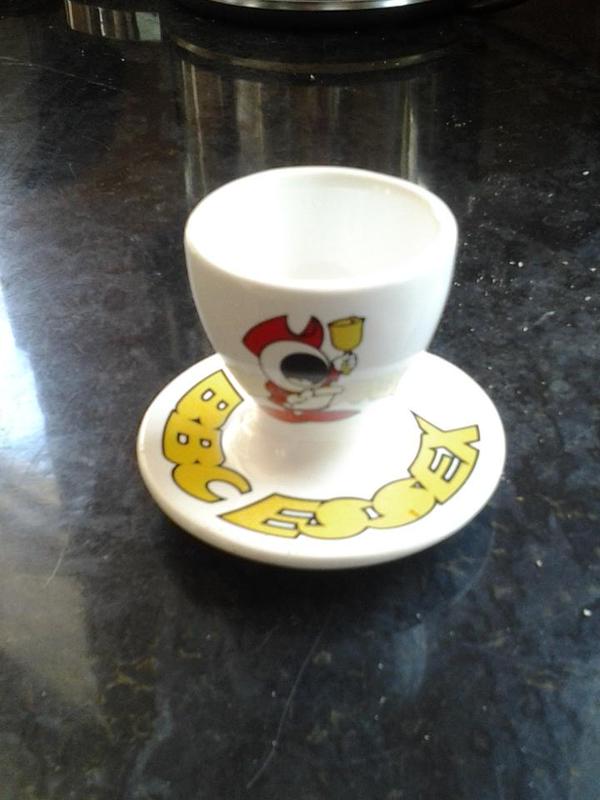
BBC Essex egg cup, thanks to Phil Shieber


My book, 'How to Make Great Radio' is out now, published by Biteback.

Stickers from Paul Teague
Memorable, huh?

Happy '60s BBC local days
Eggy fun from BBC WM, thanks to David Butler
Good grief. 

Do Tweet more of these to me @davidlloydradio

Thursday, 18 June 2015

You’re up to date, I’m Fred Farnsbarns

Why do people insist on proclaiming their own name when they appear on the radio?  

It’s a policy I can defend with energy for regular programme presenters who spend hours each day with their listeners, for years and years.  For those personalities and on most formats, it’s only polite every now and again to shake hands with the dear listener, say hello and announce who you are.

What is a little more puzzling is when ever-changing contributors diminish their short time on air by announcing their name as though it truly is much more important than anything else.  The travel, weather and news headline folk really seem hell-bent on trumpeting their name sufficiently clearly for their mothers to hear. 

On some stations, by the time we’ve got through the station jingle and sponsor, and they've announced the fact that they are about to deliver the travel news and announced their name in full, there’s scant time for the hold-up on the M1.

On others, we are formally introduced to the nasal work experience lad who’s been asked to voice a news report into which he’s had no input, for no discernible reason. His identity is of no relevance and adds no weight to the contribution. He's hardly our Home Affairs correspondent.

This headline position of the contributor's name suggests someone believes it is the most important thing of all.

Again, if you are an expert correspondent in your field, ‘part of the show’, the whole show (whatever the format), or make a regular substantive contribution, there’s a good case to be made for saying who you are.  In those cases, your reputation and familiarity brings value.  On a fast-moving rota, where different thoroughly proficient voices pop up across the schedule, delivering utility information without reputation, do listeners really care too much to whom those honeyed tones belong?

I wonder why we do it.  In my experience, sadly, most listeners to many successful music stations only just remember the names of excellent presenters, even though they appear for hours every day.  How many would actually recall the names of the folk providing the many breathless cameos?

It was not always thus.  Until the ‘30s, British news bulletins simply launched straight into the latest delicate headlines from the Empire, delivered in impeccable tones.  The perils of wartime, however, brought a risk that bulletins from other less reliable foreign sources might be confused with Auntie's. At a time where the first casualty is said to be the truth, it was felt that listeners “must be able to recognise instantly the authentic voice of BBC broadcasting".

The instruction was accordingly issued that newsreaders should identify themselves.  FrankPhillips was first to do it - 75 years ago, in July 1940.

Back then, they made a meal of it too: ‘here is the news - and this is Alvar Lidellreading it’. 

Identifying yourself brings its price too: listeners know who to blame.  One irate listener scribbled a neat note to the DG after hearing Phillips purring from his Bakelite set: "sack that man immediately; we'll never win the war while he is reading the news".

Now, everyone’s cottoned on, and we’re all hissing our names, regardless of the relevance. Maybe we should extend the policy by introducing ourselves proudly by name each night to the checkout operator at Tesco. I could even play my accapella name-checks to them from my phone, come to that.

This July, the habit is 75 years old.  Do we still need quite so many names in quite so many places? Time for a re-think now the War’s over?

That was David Lloyd  reporting.


Saturday, 16 May 2015

A blog about a book: 'How to Make Great Radio'

Over dinner in my favourite Indian restaurant in Nottingham recently, I was rambling intolerably about 'my book' to one of my cynical but lovely radio friends.  I told him I'd learned loads whilst writing it. '"What like?", he asked, as he stuffed a naan bread in his face.

So, when the Jiffy bag finally arrived from the publishers last week, bearing ten lovely-smelling first copies of my humble publication, I thumbed gingerly through the pages, to remind myself what I hadn't known when I started to write it.

Every day in radio is a school day, not least when you're trying madly to justify, or disprove, those 'radio assumptions'.

I thought I was the only competition cynic until I stumbled across the words of legendary American programmer, Bill Drake: "We did a lot of on-air promotions at KHJ, and we did almost none at KFRC in San Francisco. Both stations were successful". In his opinion, "most contests are garbage".  He's surely right; far too many offer little in the way of witness value. They are either too demanding, too dull or too exclusive; with prizes seen as unattainable and mechanics focused on the minority taking part, not the majority listening.  Gone are the days when the radio station was the only place you could win a decent prize.  BBC Local Radio, which suspended contesting in the days when it was discredited, would likely concede that their stations are better without  many of them.  Cheers, Bill. Nice to stumble across substantiation for my prejudice.


Isn't it annoying when 'major names' pop up on radio who fail to grasp the 'one listener' thing.  That 'You' thing.  They drone on about "anyone out there'" and getting my 'thinking caps' on.  For goodness sake, anyone who knows anything about our great medium knows that the most important word is 'you'.  If it's good enough for Ken Bruce: 'People respond to one person – talking to them as one person’; and Wogan: ‘Radio engages because you talk to an individual’, it should be good enough for the rest of us. I also cite some early crackly recordings from the 'first' disc jockey, Christopher Stone, from 1927 who said in his show: 'I know you'd like to hear some more of that, and so would I".  Almost a century ago, and at the very beginnings of our medium, he'd nailed it.

Few candidates in the last General Election stood up to make a speech without offering an anecdote about the chap they'd 'bumped into' the night before.  We know that story-telling works.  The greatest presenters master the art on radio.  The greatest ads call upon it.  Vocabulary, pace and detail create colourful pictures.  In researching the book too, I was drawn too to the words of John Cleese, who spoke of the mental 'skip' the listener makes from the start of a tale to the punchline.  In that skip lies the pleasure and amusement. Too large, it fails, Too small it offers no satisfaction.  One word can make a difference.  Even if just a  swear-word: ‘You were only supposed to blow the bloody doors off!’

Why do some newsreaders whine every sentence and inexplicably draw out the last word, regardless of its significance?  Accomplished voice coach, Kate Lee, suggests that great reading is often about ‘sounding even more yourself ’. She observes how some readers appear almost intimidated by the importance of the material. Once they say to themselves ‘this is news’, she believes their brain then promptly ignores all all the natural nuances of conversation. Contemporary, conversational news delivery is a real art.

Fascinated by the way the 'mood' in a studio can change what comes out the speakers the other end, it was great to hear the anecdote about a leading performer who used to play the Cagney & Lacey theme tune before starting his show.  Off on that tangent, I then stumbled across how both David Cameron, and indeed Enoch Powell in his time, observed that a full bladder kept their mind alert and their speeches powerful.  Maybe not one to try.

I stumbled across some fascinating material about the voice and how it engages so well on radio.  Including the theory that the 'disembodied voice' on the radio connects with the listener as does a mother's voice to a child in the womb.


And who would not want to know the story of the birth of tight, Top 40 format radio in a bar in Omaha, Nebraska.  Next time one of your listeners complains about hearing the same song over and over again, you'll want to know that tale too. 

And so the list goes on.  I learned a little more about mic technique; commentary; interviewing; the psychological response to words; and getting callers on-air.  I mused about dealing with over-enthusiastic listeners; spoke to some great producers; and delved into the use of social media.  I stumbled across some brilliant old research about the relative merits of male and female voices; and I counted the words per minute which Wogan deployed as he said his last breakfast farewell. 

I was persuaded to add a chapter about how to get into our medium; and I volunteered another about how to keep your job.  And some necessary caution on risk-taking, 'stunting', research, law and compliance.

Given that text books are boring and the chances of any publisher agreeing to my autobiography are slim, I've littered the book with anecdotes from my lucky time in the business.  Lest I forget the two occasions when the police have called into reception; Dale Winton's interview techniques; or the words of advice Mrs. Thatcher's daughter proffered on programme preparation.

And there's the chapter about teasing.

As every 'author' will understand, the awful thing about writing a book is that the second your work is despatched to the publisher, you think of something you should have included. Plus, last Autumn, no-one new what Perisope was. Things now change by the day in our great radio world.

Many thanks to the likes of Matthew Bannister, Christian O'Connell, John Myers, Ben Cooper and Nick Ferrari for offering generous early reviews.  What's useful is that they suggest it's by no means just a book for beginners. 

Radio is rarely a matter and wrong. Some of the greats break the rules brilliantly.  And those who disagree with my mad assertions or theories will hopefully concede that the debate itself is likely helpful. Or they can write their own book.

If it helps, please grab a copy at £14.99 (£10.99 e-book) from my friends at Biteback Publishing.  Proceeds to the Radio Academy. 


Monday, 11 May 2015

Pictures from the Past

Disc jockeys are meant to be heard not seen.  But these pictures from the Getty archives really do sum up a time and a place.

Enjoy here, one of the launch pics from the opening of Radio 1 in 1967. Sir Tony staring into the camera lens, griping onto a pair of those funny BBC headphones. And what a fine bit of woodwork there from the BBC joiner.


Rosko was the rebel in those days, with his lunchtime show. Look, he's barely clothed here.  John Dunn famously introduced  his news bulletin in Rosko's show with: 'now the news. In English..."


And on the station's first birthday, the presenters famously gather feet away from Broadcasting House, to return to the steps of All Souls Church.  For many of the characters, it is the closest they'll get to singing hymns. The assembly was a little diminished from the parallel shot a year before, not least because the fledgling Radio 1 policy was to hire everyone on four week contracts and see who worked out best.  Canny approach.


Down the road at Capital, in a rare 1973 shot in his office at Euston Tower, Chairman Richard Attenborough is likely none too pleased as he peruses the company's early accounts. 


And the early team at London's LBC were no strangers to challenging accounting. In this shot, a tech op watches as Janet Street-Porter and Paul Callan present 'two in the morning' (get it?) on that launch day in October 1973.  I'd prefer to have been the tech-op, as he got to hammer the buttons on the ITC triple stacks.


Commercial radio, in a fashion, had been heard in the UK much earlier, thanks to the wobbly signal from Radio Luxembourg, after it returned following the War.  Its influence was sufficiently powerful to make stars of people like Pete Murray, later on Radio 2 and LBC. Even the Teddy Boys looked up to him. And Pete's suit looks a lot better than a sweat shirt with your name on which his descendants puzzlingly chose to wear.


Back at Capital, surely 1974 mid morning host Michael Aspel does not surely need quite so many EQ channels on his mixer.


And colleague, Kenny Everett, is evidently aghast at the contents of the Capital Radio manifesto.


As Capital's Graham Dene celebrated 5 years with the station, a cake arrived. With Michael Aspel in it. Thank goodness those rumours of radio being rife with back stabbers are false.  Technics turntables were poised  - alongside the classic Neve desk which was a stranger to PFL.


Kid Jensen arrived in the UK from Radio Luxembourg in 1975, lodging at Nottingham's Radio Trent for a year before graduating to Radio 1. Here he is, in a novel pose.  It is certainly better than clutching headphones, or pointing to an alarm clock or cheque. 


By 1976, the cult of Wogan had begun; and this talented Irishman began to relax and enjoy it. Just keep your feet away from those Gates turntables, Terry. They were truly the best.


Surprisingly little audio exists of Chris Tarrant, despite his long rule at the Capital London helm.  Maybe he was more of a listener's presenter than an anorak's - and there's little wrong with that. Thank goodness we have pictures though. Note how many more screens there are in this 2004 shot, compared with the 1960s BBC shots. 


Frank Phillips is the name of a BBC newsreader better known than many before him. Not least as it was Frank who became the first newsreader to announce his name.  All part of making British broadcasts immediately recognisable as such in times of War.  The habit stuck, and now every contributor of travel, weather, whatever commences their broadcast with a smile and a proud namecheck.  Even though the War's over.


You don't see many of those discussion booths now: minimalist acoustic rooms equipped with just a bouncy table, a mic and a talkback box, thanks to the show engineering happening 'through the glass'.  Pete Murray enjoyed himself here in October 1970, with a pair of those dinky little BBC cans clipped to his 'earoles. 


The old BBC desks were industrial in style. Like cars before power steering, you had to pull these faders down with force when your needed the next jingle from the ITC cart machine.  It was no problem for good old JY, even with the future PM looking on and crashing the vocal in February 1975.


You can always tell a jingle anorak when they  concentrate more on the cart labels in a pic rather than the person pictured. Try this Radio 1 shot from the early eighties. Ignore Adrian Juste at your peril, though.


Thanks to all the photographers through the ages who have patiently witnessed our medium. We are grateful.  

One final shot.  How delicious is this. As the BBC moved premises in 1932 from Savoy Hill to the newly built Broadcasting House, a photographer paused to film the removal men at work. But why has than man got a crate on his head. And who is in the coffin?


Grab my book 'How to Make Great Radio' from Biteback. Proceeds to the Radio Academy

Sunday, 1 March 2015

And here's this week's Number One...

In our school, bringing in a radio was an offence for which you could be hanged. It was even more serious than wearing platform shoes or the wrong colour shirt.  Nevertheless, just as in totalitarian states, we ignored the law because radio meant so much.

Admittedly, we only risked the wrath so we could hear the chart, rather than the latest news from the Empire. This was a period when Tuesday lunchtime was sacred. Paul Burnett would effortlessly run down the BRAND NEW chart.  

Anxious to hear who was up and who was down, we would assemble in frozen huddles, rather hoping the marauding teachers would pursue the smell of smoke from neighbouring miscreants rather than the sound of JAM jingles from our small crowd.

Back then, blackberries, apples and oranges were confined to orchards; and radio was the only way to get the news. 

Having caught the update between Geography and double Maths on a Tuesday, we could then look forward to Sunday.   It was actually the only exciting thing about a day on which all shops were closed; the lukewarm weekly bath was taken; and that back to school feeling would hit the pit of the stomach when the miserable theme tune to 'Sing Something Simple' rang out as you searched for your PE kit.

6.00 pipped, and mother busied herself ironing and prepared to watch 'Upstairs Downstairs'.  Meanwhile, in our icy bedrooms, we would crank up the radio to enjoy the FULL Top 20. It was broadcast in stereo.  Not that anyone had a stereo radio, but mono FM was certainly better than AM.  Back then, Radio 1 was not on FM, but hijacked Radio 2’s frequencies on occasions at the weekend, presumably when the Light's delirious management had gone home for a sherry.

Like Blue Peter presenters, you can tell someone’s age by the chart show presenter they loved the most.  Some respected radio brethren go dewy-eyed at the words ‘Bruno Brookes’. Others wet themselves if anyone mentions Tom Browne.

Sunday evening was self-evidently inspired scheduling for the chart.  It had not always been thus. When Alan Dell first took a Biro to a copy of the music press in 1957 and ran down the numbers that matter most, it was scheduled late on a Sunday night.   

David Jacobs then started to assemble something more akin to our current chart, broadcast on Saturdays, before AlanFreeman barged in and appeared to prefer to work Sunday teatimes.  From that moment, whatever its name or the programme in which it was housed, the ‘chart’ has been part of our Sunday evening ritual.

The BBC possibly thought, with good cause, that the fragmented commercial radio network would never be able to assemble  a nation-wide chart offering.  Some stations had charts. Some did not.  Trent in Nottingham was allergic to anything resembling chart shows in its early ‘credible’ era, before eventually installing one which peculiarly began with the Number One.

Eventually, commercial radio’s trade body (then the Association of Independent Radio Contractors) played Kofi Annan and co-ordinated a 'Network Chart' chart offering across the commercial network of stations.  Back then, networking was rare across any stations, let alone the whole country. 

In those pre-satellite days, the chart was originally despatched down the mono ‘IRN line’, so it sounded little better than ‘Dial a Disc’ (Ask your granny about dial a disc).
David ’Kid’ Jensen was its first host, known as a ‘national name’ from his time at Radio Luxembourg  and BBC Radio 1.  Nescafe was to be its first major sponsor, although the coffee folk could not be mentioned in the programme title itself. The programme evolved, as the sponsor changed, to the Pepsi Network Chart, to the Pepsi Chart and then hit40Uk and now the Big Top 40.

It worked though. The commercial radio chart is now bigger than the BBC’s. Both are huge. 569,000 adults tune in as the BBC’s chart begins, with another 68,000 runny-nosed kids eavesdropping too.

There are few mass-appeal destination shows now on British music radio.  The days of gathering round to listen to ‘Music Whilst You Work’ are long gone.  The chart show remains the single best known appointment to listen.  It's ironic that maybe the only other is 'Pick of the Pops' on Radio 2, a retro version of the chart itself, bearing an original name.

If the BBC do re-paint this national treasure, I wish them well.  The great thing about BBC radio is that it can be first to try stuff out, without risking millions in revenue.  Rightly, their decision will be unaffected by my fond ramblings above and more influenced by the tastes and interests of a complex and savvy new generation. It would be an unnecessary cheap gag to suggest that some of those listeners nowadays would find counting to 40 a challenge.

Sunday night is a time when people are available to listen to radio, and that possibly means more than being ‘first’.  In the short term, I imagine commercial radio would benefit from the displaced audiences.  The new flavour of BBC chart would, however, find an important new place in a new generation's heart and would likely still be the one the TV shows come to when they want to do a piece about the Christmas Number One.

Presenting a chart well must merit a mention some loud applause here. It demands huge delivery skill, precision and rhythm. Maybe not quite as much skill as in bygone years, when one had to find the records, time them, then add up all their durations, and those of the ads, on the back of an envelope. 
Every word counts.  As I played back Simon Bates's first Top 40, aired in November 1978, I observed he boomed 'This week's British..." before playing the 'Britain's Number One' jingle.  With a smile, I noted in the write up that he would have kicked himself for doing that.  He tweeted to let me know he had. Let it go, Simon. Let it go.

Whilst radio will remain powerful and special for a good few generations yet, I cannot help feeling that no 15 year old would ever bother breaking a rule for it nowadays.  What I am sure of, however, is that this very Sunday, some teenager would have listened to Marvin Humes or Clara Amfo and thought "that's what i want to do when i grow up".


Grab a copy of my book 'How to Make Great Radio', published by Biteback


What can radio learn from how it has handled COVID 19?

In times like this, you turn to your friends. And radio is a friend. Day or night, it’s there to pick-you up, to comfort you, to explai...