Showing posts with label DJs. Show all posts

Friday, 17 July 2015

Mug or a sticker?

It's the only mug I never drink out of. Such happy red and blue adolescent memories, brought back by the best radio logo in the World. The Radio 1 Thunderbirds logo.  To me, that earthenware mug is worth more than a piece of Clarice Cliff.

Not all radio station merchandising ends up being quite as precious. There was much excitement when Graham Knight, presenter of the then compulsory lunchtime magazine programme at Radio Trent, took delivery of his merchandising.  Gaudy, cheap, purple pens had been ordered, inscribed with the name of his programme 'Trent Topic'.

As Graham  opened the big box, his face fell as he realised the printers, less familiar with the programming demands of the IBA, had printed 'Trent Tropic' instead.  The pens were never sent back to whichever country had printed them; I think we gave them away on the programme one fortunate hot day in what must have seemed like an immaculately planned Summery contest. 

Radio stations loved merchandising. Back then it seemed cool to show the world which station you listened to.  Some individuals would happily live their lives wearing a branded T shirt or sweat shirt.

Pic courtesy of David Smith (Simon Parry)
On acquiring the old Centre Radio premises from the liquidators, the eager marketing manager at its replacement, Leicester Sound, scratched his head on what to do with a million T shirts bearing the name of the station's ill-fated predecessor.  Probably over a drink at the nearby Marquis, the idea was hatched to overprint each with the new logo and word 'recycled' .  An idea ahead of its time, actually.

Leicester Sound loved its merchandise.  We had sweet little teddy bears with logos on their chests; and long promos on-air boasted their merits.  Wonderful Wendy on reception also sold branded, baggy boxer shorts.  These were the Nick Kamen days when baggy was in. They were available in small, medium and large; although a surfeit of the latter appeared to be sold to most of the visiting listeners, as I recall. With male and female options in stock, Wendy would ask whether they sought ones with an opening - or without.  

Thinking back, in those days, Leicester Sound probably earned more from merchandising than the radio business. Mind you, they were tough days for the medium. Profits from the Coke machine even helped. For most stations though, despite the best of intentions, merchandising stock attracts dust and bills. The size of the order inversely proportional to the likelihood of the presenter or station name/logo remaining sufficiently long.

Mouse mats went through a phase of popularity; as did baseball hats and furry bugs. James Cridland reminds me that Viking in Hull offered skimpy knickers bearing the station's mascot 'Eric the Viking', until the idea failed to find favour with the station's new owners. And the there were the Pennine radio rain-hoods for those rainy Bradford days. 

Mugs have been the great survivor. Some stations still have them. You cannot not find  a mug useful. It always has value. Some stations, however, would be well advised to seek advice on the design and wording before pressing send on their order; especially BBC local stations.

Car stickers too endure. Some stations, again, seem tempted to devise creative designs which can only be seen as you crash into the car in front.


In fact, all these years on, everything has changed about our medium: technology; ownership; brand names; music; presenters; regulator; and ownership. The only constants are arguably just those mugs and stickers.  

Do let me have a pic of your favourite example of station merchandising.Just for fun, of course.
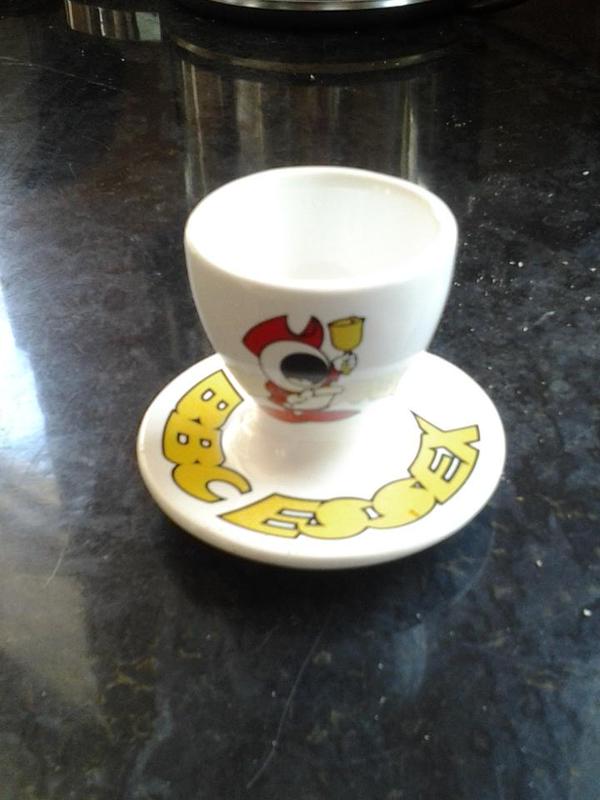
BBC Essex egg cup, thanks to Phil Shieber


My book, 'How to Make Great Radio' is out now, published by Biteback.

Stickers from Paul Teague
Memorable, huh?

Happy '60s BBC local days
Eggy fun from BBC WM, thanks to David Butler
Good grief. 

Do Tweet more of these to me @davidlloydradio

Thursday, 29 January 2015

National Digital Radio - The Future

I calculate I have nineteen DAB radios.  It’s a little over the top I know.  Hats off to Hertfordshire’s Pure for doing some great early running on the sets; and to Yorkshire’s Roberts for their sturdy classics.  And to Psion for coming up with their spiky PC peripheral Wavefinder; and to Wayne Hemingway for designing ‘the Bug’, which is still my favourite aesthetically.

It’s all a far cry from 1993 when I sat in the offices of the then regulator, the Radio Authority,  at Holbrook House to be trusted with what would have been one of the first DAB sets.  With components and transformers nailed to a huge plywood board, it hummed nicely and smelt of Scalextrix.

Life’s moved on since then, and after a slower start than most had hoped, DAB is now attracting a quarter of all radio listening across the UK (RAJAR W3 2014, Ipsos-Mori, UK TSA).  With the recent brand extensions being spawned on the first national multiplex, Digital One, which is now populated like a student house, one feels, at last, that the time of DAB has come. 

Now, the second national multiplex is imminent; and, at last, this country is poised to enjoy the sort of   broadcast listening choice which has been denied to us for years.  Given the small geographic size of our populous country, we have not been able to re-use FM frequencies to the extent they have in other countries.

Clearly, with my day job being at Orion Media, I’m hugely excited about our own ‘Listen2Digital’ bid to operate that multiplex, which was duly dropped off yesterday at Riverside House.  The USB stick in a sturdy manila envelope does not physically seem to do justice to the sweat and toil which went into assembling the pages of the formal application document over many, many, months.  If you’ve ever assembled a licence application, you know it feels like the A Level exam from hell.

We evidently think it’s a compelling case, and across the piste it offers a fresh new approach for national DAB radio, both in terms of the players involved and the services.  We think the public proposals are exciting; and we hope Ofcom also nods vigorously at some of the format details we have submitted in confidence which, frustratingly yet thoroughly understandably, we cannot yet speak publicly about at this stage.  I should say a big well done too to the other parties involved in the consortium: the mighty Babcock, who’ll be assembling the transmission infrastructure, and our good friends at Folder Media and Sabras.

The other great news is that Gem, currently our East Midlands FM AC service, would go
national, as one of our 18 proposed services.  There is no AC brand on national commercial DAB at present, with Heart operating only on local DAB, so its service is not taken into account as the applications are judged by the regulator.  AC is, therefore, a gaping hole in national provision and we reckon we’ve got the very best answer to it.  The AC audience also sits in the female 25-44 commercial hot-spot, helping to ensure the success of our business, and contribute to much-needed growth and stability for DAB.

Adult Contemporary proved of huge appeal in our extensive national research.  It is a hugely popular format across the World; and it’s strange to believe that it did not really arrive in the UK until our Chairman, Phil Riley, launched the Heart brand in the West Midlands in 1994.  He had hair back then, as he started his 13 year tenure running the format, so it’s no surprise he knows what he’s doing in arguing the AC case with our investors.  Maybe we should have roadsigns at the edge of all our cities, East and West, suggesting that the Midlands is the birthplace of the AC format in the UK.  I’ll get my paintbrush out.   

I’m personally hugely proud, not least because I’m a Nottingham lad.  In three years, Gem has achieved huge East Midlands success, becoming market leader by hours in several audience sweeps, and beating all audience levels for any station ever on that 106 FM frequency.  Let’s remember that 106 was a love-child in so many acquisitions, and being batted from owner to owner, it has operated variously as Radio 106, Century and Heart.  We have done well, despite good old Heart remaining on DAB in the patch and no TV platform for Gem.

It’s won because it’s a great product, and Mike Newman and the team there, including Naomi Robson and Andy Price heading the marketing efforts deserve plaudits.  They’ve built an AC format with real spirit, and one commanding real engagement, judging by all the qualitative research and feedback we garner.  It already has the polish of a national brand.

Sam & Amy have played a great part too, aided by Dangerous Dave and produced by Paul Iliffe.  That show has turned into a national treasure, carrying off Radio Academy awards in categories populated otherwise by indignant London and national names. The real crown just has to be that ‘Personality of the Year’ award last year.  The programme is British breakfast radio at its best; and we look forward to twisting a version of that product round for the national service.

May we plead that Ofcom put all else to one side and make this licence award as quickly as possible. We’re anxious to get on with the job.


Wednesday, 25 June 2014

The Psychology of Radio - 1935 style

“It has already grown from the insignificance of an embryonic idea in the minds of technicians to the stature of a Goliath in industry and public affairs. Vigorously endowed and shrewdly directed, it has developed sturdily, and with lightning speed has fashioned for itself a place in our national life” 

So says a 1935 book called ‘The Psychology of Radio’. 

The book was written in America, back in the days when radio was but a small child, and self-appointed experts were penning articles and posturing about it.  Just as they do about this digital thing nearly eighty years later.

It’s a fascinating read.  It makes mention of an impressive early experiment, conducted when there was an appetite to understand better this new fangled thing.  An evangelist gathered an audience and preached in a hall.  His sermon was relayed by sound only, as if a radio broadcast, to a neighbouring hall.  As the call came for the congregation to step forward and participate, the genuine assembly started to take action.  Members of the radio audience in the second hall were not motivated in the same way.  They stood there like lemons.

The author explained he felt this was not through some flaw in this otherwise miraculous medium, but simply because the vocal delivery on radio needed to be different.  In structure, it was said that a live speaker works for “immediate rather than long-run results, for emotional fervour rather than for future action”.  

He concluded:

“A radio spellbinder would have spoken quite differently. He would have used less bombast and more artistry, less brute force and more cunning. He would have directed his attention to the invisible audience and would have made each listener feel welcome as a member of the circle. He would have aroused the listeners' sense of participation in the occasion. "Friends, this is Huey P. Long speaking.."

All those years ago, the authors (Hadley Cantril  & Gordon Allport) had already recognised that radio was a one-to-one thing; and you had to address a single listener as you spoke if you really wanted to motivate.

The chapter observed that the voice on radio is different from a person addressing in real life in that:

  • “In the minds of the listeners (radio) places music in the preferred position among radio program(me)s.
  • It frees the listener from the necessity of conventional politeness toward public performers.
  • It interposes a serious psychological barrier between the broadcaster and his audience through the destruction of the normal circular relationship.
  • It virtually eliminates social facilitation among the auditors with the result that they are less crowdish, more critical and individualistic”.

Witness the medium’s educational prowess too. The publication suggests that radio improves the capacity of the average man to listen. And even “probably increases the vocabulary of the average listener”.

“It was discovered that the college student, with his long training in listening to lectures, is far better able than the untrained listener to understand and to recall what he hears. His advantage, furthermore,is discovered to be greater for auditory than for visual material. It appears, therefore, that intelligent listening is par excellence the mark of the educated man.”

“Although there is a prevailing tendency to use the radio as a background for other tasks, when the dial is turned to a specific program and when attention is directed fully to its message, an auditory training is provided for millions of people and its long-range effects may be exceedingly important. For increasing the world's population of "good listeners" radio deserves an extra star in its crown”.

So, if the boss ever tells you to stop streaming Gem 106 at your desk, just smile patiently and assure him that it’s training you to listen better to his wisdom.

Even back then there was a worry that radio might put people off their work

“Take, first, the case of the housewife or the student who is completely preoccupied with work. The loud-speaker emits its stream of sound, but it falls on deaf ears. The distraction is completely inhibited. As long as attention does not shift, the radio's effect, if it has any at all, is entirely subliminal. In such a case the effort required (and unconsciously exerted) to overcome the distraction may actually enhance concentration on the task in hand.... The stronger the potential distraction the greater is the compensatory attention”.

Attention, RAB! The article goes on to provide early thoughts on the topic addressed in more recent years by Saatchi & Saatchi's 1981/1995 'Ironing Board Study' and Classic FM’s/Bournemouth University's 1995 'Jigsaw study'. The theory that listeners zone in and out depending on what interests them:

“However, attention is at best a restless thing, always waxing and waning, and shifting from one focus to another. The sounds of the radio are seldom inhibited for more than a few minutes at a time.  The mind wanders from the task in hand to the distracting sound”.

Some things have come to pass:

“In certain ways radio is a dangerous competitor of the newspaper.”

And some prophetic observations on the delinquent use of radio’s immense power:


“The Nazi propagandist minister, Goebbels, uses it ubiquitously to spread the doctrines of Hitler and says that ''Some day the radio will be the spiritual daily bread of the whole German nation."

What about children though?

“About one-third of the children say that they lie awake in bed thinking of things they have heard over the radio. The same number report that they frequently dream of radio plots : three- fourths of these dreams are nightmares”.

Given American radio was, by then, already into commercial radio full throttle, the book also alludes to what later became ‘pester power’ in terms to children hearing advertisements and then lobbying poor Mama for said goodies:

“ The advertising appeal is ingenious and effective. It is directed toward the child's desire for physical superiority (victory at games and ''pep"). It comes just before the supper hour when hunger facilitates mental associations pertaining to food. It arouses the powerful motive of sympathy and compassion by asking the child to tell his mother about the product... Through repetition, tedious to the adult but interesting to the child, the association between the fantasy of the story and the product in question is indelibly established”.

Ah. Repetition builds reputation.

What of station formats?

  • “a slight majority of this station's hours are devoted to network”
  • “far more network programs are broadcast on Sundays than on weekdays;
  • “the early morning hours (6-8) contain entirely local programs”
  • “three-fourths of the programs broadcast during the best evening hours (7-10) are network relays;
  • “the days when listening habits are least dependable (over the week-end) are filled with sustaining network broadcasts to keep the station on the air most economically..”
So, the truth is out.  In implementing 'The Future of Radio' in 2007, OFCOM just copied and pasted from this 1935 book for its Localness Guidelines.

By the way, according to the 1930 US census (which likely enjoyed jolly COI-type ads saying “fill in the form y’all”), there were suggestions that 70 per cent of homes were, were “supplied with radios”.  

If the behavioural assertions above are to be believed, the rest of the homes contained thick Americans with fairly chilled kids.

This is amazing. Average listening time was 19.6 hours a week. In 2014, it is 21.5.  The sample size was 507, by the way if Ipsos/Mori are reading this.  

Popular programme elements included ‘Dance Orchestras’ at Number 1 in the chart, followed by football and symphonies. Wow.  It’s commercial national radio. Absolute, Talksport and Classic.  Sports and old songs are in there too, in the next two positions, so thank goodness we have Smooth.  Least popular thing? “Advertising messages”.

How many stations in the listening repertoire back in the 1930s?

 “The average listener is not accustomed to tune in to all available stations. His habits at the dial are likely to be rutted: 5.6 per cent listen regularly to only one station while 76.6% per cent never listen to more than three stations”.

All these years later, the ‘habits at the dial’ of the average punter are much the same.

There’s some handy listener research, suggesting that 84% preferred music programming, with the remainder opting for speech. It also suggests that speech is used as foreground listening and music as background.

Forgive me for just lapping up the experiments on presenter voices, conducted by WEEI in Boston involving the tones of  twenty-four male (but of course) speakers and over six hundred judges. They sought to establish whether people could judge appearance by a voice.  We must try that trial again. A great contest for your breakfast show, maybe.

They  found that it was challenging to establish height from a voice, although some favourable results were uncovered owing “primarily to the case of a short fat man whose voice was thick, mellow, and "chuckling." . Give that guy a job on Radio 2.

Voices were matched to  handwriting “about one and a half times as frequently as would be expected by chance.”

Photos and voices were matched with some success as was political preference.  Close your eyes. Listen to Nick Ferrari and try to establish which way he votes.

I shall leave you with a brief glimpse into Chapter 7.

“Most people would rather hear a man than a woman speak over the radio. Yet few listeners are able to explain this preference: they can tell neither how the sexes differ in their vocal appeal nor why. Even the supervisor of broadcasting at the studio can seldom give reasons why his announcing staff is entirely male.”

I bet he can’t.

They resorted to another fab experiment with men and women reading articles into a microphone and  respondents were asked to score on various factors. 

"Women were found to be rated higher in some qualities and men in others. In general men are judged to be more natural and more persuasive. Except in poetry and abstract passages, the listeners felt that men took more of an interest in the material they were broadcasting. In four out of seven experiments, women's voices were judged as more attractive".

Before the analysis, 95 per cent of the listeners had already stated that men's voices were more attractive.  The conclusion states:

“This result shows a noteworthy difference between stereotyped and analytic judgments. It indicates that the preliminary judgment was based to a considerable degree upon mere prejudice”

How far have we really come in 80 years?


Grab my book 'How to Make Great Radio'. Published by Biteback. https://www.bitebackpublishing.com/books/how-to-make-great-radio


Saturday, 24 August 2013

Muttering darkly over muffins

O
Sheila Borrett was said to be the first women  'announcer' on UK radio.  Despite the BBC's enthusiasm, the Radio Times was cautious when announcing her arrival in 1933.  It suggested that retired colonels might "mutter darkly over their muffins".

The predictions of unrest were correct and thousands of letters were received criticising poor Sheila.  Mainly from women.  After three months, she was moved on from the role; and one can but imagine the probation conversation with HR in those distant non-PC days.

80 years on, it's high time the topic was indeed back on the agenda; and Tony Hall is to be congratulated on doing rather more than floating an encouraging remark.

Thankfully, men and women are different.  As the best-selling book suggests, 'Men are from Mars and Women are from Venus'. They each have, in general terms, a different way of looking at the World around them; and they communicate in different ways. 

In the magnificent 'Watching the English' book by anthropologist, Kate Fox, she observes that women communicate in a group as one melee. When they assemble socially, they may all readily speak at once and enjoy a simultaneous conversation.  Men tend to shout through the gaps.  Kate's female focus groups lamented too that men are not good at gossip. It was suggested the guys miss out the crucial 'he said/she said' attribution; and use a 'flat unemotional manner'.

I muse that when son or daughter calls home, they chat to dad about 'what they're doing' and to mum about 'how they're feeling'.  Research suggests that male-to-male phone conversations last 4.6 minutes, versus a 7.1 minute average for a women to women call*.  Women can talk incessantly about a range of topics.  Men often resort to sport, jokes, work; or the pub argument.  The latter is safe territory and it frequently bores me stupid.

Over time, might it be that men on-air have learnt to compensate for the inadequacies of their gender?  They have adopted coping techniques from each other over the generations; and just maybe there are too few female role models for women to adapt similarly with ease.  I can point to a handful of stunning male broadcasters I emulated in my early days; and I borrowed  a skill from each one.  Given the paucity of women on-air, can a fresh women broadcaster draw from the same range of excellent performers with ease?

I have a hunch that on-air, men become the people they'd like to be.  They draw out the most favourable characteristics and amplify them, turning up the sympathy and emotions, and turning down the rough edges.  And succintness, well, that's blokes all over.  Women, being more social animals, are probably themselves on-air, and behave 'normally'.  Whilst 'be yourself' is a useful adage, every broadcaster knows that 'being yourself is not enough; and sounding 'normal' is an art.

Men are often less expressive than women in how they dress and how they animate conversations;  so little is absent when the voice is their only tool.  Women make much use of those additional dimensions, which are stripped away when only the voice remains as the sole communication conduit.

Women have shorter vocal chords and thus, generally, higher voices.  I'm sure you've heard about that mysterious bit of research which suggested that both women and men prefer listening to men on the radio.  I'm equally sure you've never seen a copy.  There is lots of research into recall of, and passion for, various tones of voices, although most data appears to lack the context of radio.  

Some of the earliest 'pop radio women', for example Annie Nightingale, did draw upon deeper tones; and we know that Margaret Thatcher was trainedto lower her voice by a coach from the National Theatre.  We also know that blokes on-air have a hissy fit if someone tampers with the butch settings on their EQ.  

'Deeper voices' may well be found more attractive but many great women on air have rounded, beautifully rich voices; and many successful men on-air have not.  Neither Jonathan Ross nor Chris Evans have perfect radio voices, but they've enjoyed a modicum of success.  

It is true, however, that radio listeners like the familiar more than the unfamiliar, and male voices on air have come to be expected.

There are some pretty awful women on the radio; and there are some pretty awful men. Statistically, there are many more awful men than awful women.

Radio 4's 'Today Programme' gender dilemma has been played out publicly. John Humphrys has suggested that when he eventually ceases his dawn harrumphing, his stints will likely be assumed by a woman.  Already, with Mishal Hussain's arrival, the jostling has begun.  

We recall the redoubtable Sue MacGregor and lament the fact that we have yet to hear any other woman on that programme recently with quite her conviction and ability.  Mind you, I could similarly, frankly, draw my own league table of the blokes on the programme too. The weaker links in the male chain, and they surely do exist on that programme, will wrongly attract less scrutiny than the women.

Witness too the wonderful  Anne-Marie Minhall on Classic FM; and, I have to say, there was something endearing about Sarah Kennedy's ramblings.  Jane Garvey has talents to die for.  Gloria Hunniford is sadly lost to radio, but I would cite Vanessa Feltz as being one of the more  interesting characters on-air.  Whilst I would not say I am a huge fan of everything she does, the challenges of her own life have enriched her act.  Her openness and thus seeming vulnerability help a listener feel that they know her.  Caroline Martin at BBC WM also shares that 'flawed' charm; and it's a huge asset for both sexes.  Too rarely do you hear women really being women on the air.  Too many pretend to be men; and that's a shame.

As I write the above paragraph, I smile and think of women I know who despise some of the above-named with surprising venom.  Are women more critical of each other than any man would wish to be?

In commercial radio, there are few  lead women presenters on breakfast shows.  Jo & Twiggy, however, was one such act on Nottingham's Trent (now Capital), which enjoyed huge success and a mantelpiece of awards.   UK radio has shifted from 'performance' to 'real'; and the women on-air now are rightly picked for their story telling and humour rather than just as a giggling sidekick.  Might it be that women have better abilities at bantering  with real people (as a co-host) than as a sad solo presenter just pretending to talk to someone?  If that plays to a strength, then let's not ignore it.

What of the early days?  Lots of male presenters begin their radio lives as anoraks, sitting alone with  their acne in their bedrooms, listening to radio and growing to love it.  They then pursue that hobby with unhealthy energy.  Women strike me as generally less obsessive and altogether more balanced and sensible.  I know few female radio anoraks as sad as I was; although Beccy Adlington would hit me with her rubber swimming hat and remind me that there are successful female obsessives in other fields.

Skillset suggests some women make a "conscious decision to care for their children full-time or enter a different and less demanding industry". I have to say I am utterly in awe of  women I have known in senior positions who have balanced their families with huge responsibilities and jobs which are rarely 9 to 5.  I don't know quite how they do it, but they have proven they do.  In sales and often in newsrooms, there is a decent gender balance; although there is often a paucity round the Board table (17%, suggests Skillset**).  As a bloke unable to talk about football, I can quite see why women might not feel at home.

I don't count the number of audition MP3s and Soundcloud files I get sent each week, but I would hazard a guess that  well over 90% of unsolicited auditions come from lads.  When more high quality auditions are submitted by women, more will be recruited.  And we programmers must not nurture that irrational fear of two successive women on a programme schedule. 

Is it appropriate to engineer a 50% ratio of women on BBC Local Radio breakfast programmes by the end of 2014?  I would question that tactic; although I welcome a strategy. 

Is it correct to aim for a better gender balance and benchmark how the situation evolves over time? Absolutely. 

Mind you, let's remember that this self-op, multi-source, single-header breakfast show is possibly one of the most complex gigs in UK radio, and a challenge for anyone new, regardless of sex.

Listeners want their programmes to be the best they can, whomsoever presents those shows.  I wonder whether target listeners might prefer  BBC local radio to focus its efforts on how old the on-air staff are and how abreast they are of their 50+ audience rather than whether they wear a frock or not.  The BBC's first obligation is to its licence payers.

I would commend the efforts being made by the BBC to identify more female presenters; and to offer training and support to encourage those women to hone their talents.  I only hope the BBC finds within its ranks those with the skill and instinct to help coach in the above areas.  Just maybe that's a time to look outside BBC News, to which Local Radio is strangely assigned,  for those with a real insight into how radio engages if the gender imbalance is to remedy itself genuinely.

*Smoreda & Licoppe (2000) 
** Women in the UK Radio Industry, Skillset 2011


Wednesday, 17 April 2013

Bricks and Mortar

I smiled when I made the mistake of reading one of those anorak groups recently. One contributor suggested that ILR's 'downfall' began when Capital moved out of the "iconic Euston Tower" into premises "above a restaurant" in Leicester Square.  It was Kenny's magic which turned that Euston office block into the 'Tower of Power'; and I suspect the author of that post would be none too pleased were his rates to change from those of Euston Road to those of Leicester Square. 

Some radio stations have an aura. You walk in you can ‘breathe in’ the spirit of the place.   Often it’s not the building itself, it’s the history and the characters who’ve spent time there over the years. We all leave a bit of something along the way.   Often a funny tale to tell, passed from generation to generation by professional story-tellers, amplified each time.  They all seep into the brickwork. 
Regardless of the impressive new facilities at New Broadcasting House, I know a few old Bush House folk shed a tear as they walked down the Strand for the last time.
At Free Radio, we moved our Wolverhampton studio facilities to a new purpose-built location elsewhere in its broadcast area.  All very practical, frankly.  The old building was far too large for the number of people now working there.  And it leaked.  Each room was equipped with a heavy large door: great in nuclear war when you need to prop one up against a table, as instructed by the Government  ‘how to cope in WWIII’  booklets, but not so good when you are wondering what the folk in the sales team are thinking about your latest bright idea.
Free Radio Tettenhall Rd building (pic: Tom Stokes)
The old 19th Century Tettenhall Road building became a radio station in the sunshine days of 1976, when Beacon Radio came on air, the last in the first tranche of ILR commercial radio stations.  

It was a rambling old house, formerly an orphanage, housing many of those who'd lost their parents to Cholera. The screams of stroppy presenters went on to replace  those of stroppy children.  I gather the station was very nearly not based there: it was to be in Sandwell, but the management team rushed out and bought it on a whim with a cheque for £18,000.  And there it’s stayed.
It became offices after out tenure, although I mused that it would have made a great building for a nursing home for ex-disc jockeys as we all reach retirement.  The mind wanders. How much fun that would be.  We could all have a turn at the decks for the Friday night discos.  Our doorbells could play JAM accapella namechecks; happy nurses would wear satin jackets with logos on; and coffee would be served in red and blue 'Radio 1 247' mugs.


For thirty years, Trent occupied a converted house in Nottingham, well, two to be precise; and it had been a hospital too.  I think Dale Winton’s desk was plonked where matron used to sit.  If the walls of that place could speak, the tales they could tell.  I pass the battered old blue door most weeks and smile wistfully; and on quiet mornings, even touch the dimpled gold door-handle to touch my past.  This was a building which saw me grow from boy to man and I was forever intimidated by its reception area, where my acne and I sat so often before getting my first job there.  We all have a building like that in our hearts.

My quick history of the old Radio Trent building in Nottingham
Trent had ghosts.  I only mention that, as I recall that it is not the only radio station which lays claim to them.  Mind you, with the studios having been the morgue, it’s hardly surprising.  The Beacon building is said to haunted too, as, reportedly, was the old 1876 ecclesiastic Leicester Sound building.  I gather someone hanged themselves on the stairs there in its life before radio.  The station nearly drove me to that on occasions.

I recall from friends around the network that many other stations chose buildings with rich histories.  Red Rose Radio was based in a former church, where hardened journalists feared the late shift; and GWR Wiltshire suggests its newsroom boasted a ghost which switched its TV to adult channels overnight. Yeah, yeah.
Chris Evans writes in his book about hanging around at the Piccadilly Plaza in his Manchester youth, and awful though that original radio station building, built in 1959, eventually became, I’m sure in later years, he’d still stare at it and smile.
Capital’s building in Leeds is still very much alive with great living, breathing, radio; and there is another of those buildings which you ‘feel’ as you walk in.  Not so much for the Joseph's Well brickwork, or indeed location (talk to them about the day when Boy George turned up at the car park), but because you can feel the energy as you walk in.  
And Golden Square, the beautifully decorated home of Absolute - and a fund of memories.  There is another of radio’s stately homes.  Why is that?  Because of the characters who’ve passed through it.  And, as ownership changes again, thoughts return to those who’ve shouted, cried and laughed between its four walls.  And, one imagines, feelings surface that Golden Square may not be forever the home of that legacy.

Most of the first 73-79 generation of stations have now waved farewell to the rent, leaks and spooks of the buildings in which they launched. Who's left? The Pulse (Pennine)?  Possibly a couple more, but the list is small.

As we wave farewell to Tettenhall Road as a broadcasting base after 37  years, it's a chance for a last farewell glance at one of commercial radio's original stately homes, and the people within,  before we put the key in the Chubb for the last time:


                                                             The Tettenhall Road Years 

But really, it’s not about buildings.  It's about the teams and the people.  They energise the space, not the other way round.  

The future?  Is radio an operation which always needs a single building? It's amazing what a presenter can do with a few egg-boxes, a Soundcraft mixer and a blanket draped round their head.


Monday, 1 April 2013

Words don't come easy


When a presenter says 'keep your texts coming in', I picture an elderly lady hunched over a large mobile phone frantically despatching repeated texts to the radio station, in dutiful response to the instruction.

In truth, the presenter really wants each listener to sends a single text.  As a broadcaster you want to motivate one listener to do one thing, once. 'Text me'. When that connection happens powerfully, scale results.

As Terry Wogan said to Andrew Neil on 'This Week', radio engages because you 'talk to an individual'.  Terry's words are correct. Whilst his Radio 2 transmitters beamed out to millions, he sounded as though he was just mumbling to you.  That great relationship between radio station and listener exists because every listener feels the presenter is addressing them alone.   That's why, when listeners do get in touch with you, they use the same language to you as they would to a friend.

Whilst this 'talk to a single listener' lesson is probably the first thing most broadcasters wisely learn when venturing into radio, it's surprising how many presenters appear to have had that page of the rules ripped out of their copy of the presenter bible. They'll announce that 'lots of you have been in touch'. Lots of Me? As I  look around my room, like so many radio listeners, I am alone. The presenter appears to be addressing a large  assembly somewhere else. 'Keep your calls coming in'. Goodness, I have not made one yet. You must be talking to someone else, not me.  

Winston Churchill would probably agree with me that words do make a difference. As would every sports captain giving a half-time pep talk. In fact, if we truly believe that a few words here and there make no difference then  we should agree there is no difference between the best and the worst broadcaster. Rudyard Kipling suggested that “Words are, of course, the most powerful drug used by mankind.” 

It's easy to pick up bad habits.  That officious passive language, as befits railway announcements like 'passengers are reminded that', can creep into both presenter banter and the 'tickets can be obtained from' phrasing of on-air promos.

Then there are those lovely travel cliches, including the 'earlier accident'. As opposed to the one which is just about to happen, I guess.  Hopefully, though, the travel news has been ordered in a sensible way, telling me where the incident is first, before the detail. And the presenter has avoided the common 'over in X' error, and has acknowledged that the presenter and the listener are actually in the same place. You are on their radio in their car, in Scotland.

Don't you just Iove those lovely lengthy show menus: 'all that - and more - between now and 10.00'.  What a great idea it must appear to be  to highlight the time at which the show will end. The show menu is usually inordinately long too, forgetting that great 'round of drinks' analogy: when you're asked to go to fetch a round of drinks, there's only so much information you can store in your head. And of course, there are the presenters  who trumpet a vaguely familiar guest's name and hope that alone is sufficient to tempt me to listen, rather than telling me something interesting about what they might say.

Poor language gets in the way.  You're more likely to get a personal story from a listener when you say 'give me a call', than if you say 'call us here at the station'. The listener trusts you. They're more likely to share something with you than your 'team' 'through the glass'.  

When you're on air, stare your single listener in the eyes. Talk to them, and only them. Ask them questions. Give them time to nod, smile, or shake their head.

Mind you, we are such a polite bunch. If we are introduced by a colleague on-air, we say 'thanks, Shirley'. Why are we thanking her though? Just for mentioning our name? How bizarre. Sometimes it's even politer 'thank you very much indeed there, Shirley'. It's likely a reflex action, to afford the presenter sufficient time to compose themselves, in much the same way that so many news reporters say 'good morning' before beginning their live reports.  Even if those despatches are about a murder.  There's little good about mornings like that.  

TV reporters can be even jollier with the delicious 'a very good morning to you'. How often do we hear that phrase in the real world? Ever?

And, not largely relevant, but it gets it out my system. What about time checks?  Why do normal grown-ups start saying '18 before 2' when they get on the radio, even on BBC stations?  And when 'it's just coming round to 21 and a half minutes past 8', should we maybe be eternally grateful for that imprecise precision? It's just not what you would say.

Follow my #radiomoments daily on Twitter @davidlloydradio


What can radio learn from how it has handled COVID 19?

In times like this, you turn to your friends. And radio is a friend. Day or night, it’s there to pick-you up, to comfort you, to explai...