Showing posts with label disc jockey. Show all posts

Sunday, 1 March 2015

And here's this week's Number One...

In our school, bringing in a radio was an offence for which you could be hanged. It was even more serious than wearing platform shoes or the wrong colour shirt.  Nevertheless, just as in totalitarian states, we ignored the law because radio meant so much.

Admittedly, we only risked the wrath so we could hear the chart, rather than the latest news from the Empire. This was a period when Tuesday lunchtime was sacred. Paul Burnett would effortlessly run down the BRAND NEW chart.  

Anxious to hear who was up and who was down, we would assemble in frozen huddles, rather hoping the marauding teachers would pursue the smell of smoke from neighbouring miscreants rather than the sound of JAM jingles from our small crowd.

Back then, blackberries, apples and oranges were confined to orchards; and radio was the only way to get the news. 

Having caught the update between Geography and double Maths on a Tuesday, we could then look forward to Sunday.   It was actually the only exciting thing about a day on which all shops were closed; the lukewarm weekly bath was taken; and that back to school feeling would hit the pit of the stomach when the miserable theme tune to 'Sing Something Simple' rang out as you searched for your PE kit.

6.00 pipped, and mother busied herself ironing and prepared to watch 'Upstairs Downstairs'.  Meanwhile, in our icy bedrooms, we would crank up the radio to enjoy the FULL Top 20. It was broadcast in stereo.  Not that anyone had a stereo radio, but mono FM was certainly better than AM.  Back then, Radio 1 was not on FM, but hijacked Radio 2’s frequencies on occasions at the weekend, presumably when the Light's delirious management had gone home for a sherry.

Like Blue Peter presenters, you can tell someone’s age by the chart show presenter they loved the most.  Some respected radio brethren go dewy-eyed at the words ‘Bruno Brookes’. Others wet themselves if anyone mentions Tom Browne.

Sunday evening was self-evidently inspired scheduling for the chart.  It had not always been thus. When Alan Dell first took a Biro to a copy of the music press in 1957 and ran down the numbers that matter most, it was scheduled late on a Sunday night.   

David Jacobs then started to assemble something more akin to our current chart, broadcast on Saturdays, before AlanFreeman barged in and appeared to prefer to work Sunday teatimes.  From that moment, whatever its name or the programme in which it was housed, the ‘chart’ has been part of our Sunday evening ritual.

The BBC possibly thought, with good cause, that the fragmented commercial radio network would never be able to assemble  a nation-wide chart offering.  Some stations had charts. Some did not.  Trent in Nottingham was allergic to anything resembling chart shows in its early ‘credible’ era, before eventually installing one which peculiarly began with the Number One.

Eventually, commercial radio’s trade body (then the Association of Independent Radio Contractors) played Kofi Annan and co-ordinated a 'Network Chart' chart offering across the commercial network of stations.  Back then, networking was rare across any stations, let alone the whole country. 

In those pre-satellite days, the chart was originally despatched down the mono ‘IRN line’, so it sounded little better than ‘Dial a Disc’ (Ask your granny about dial a disc).
David ’Kid’ Jensen was its first host, known as a ‘national name’ from his time at Radio Luxembourg  and BBC Radio 1.  Nescafe was to be its first major sponsor, although the coffee folk could not be mentioned in the programme title itself. The programme evolved, as the sponsor changed, to the Pepsi Network Chart, to the Pepsi Chart and then hit40Uk and now the Big Top 40.

It worked though. The commercial radio chart is now bigger than the BBC’s. Both are huge. 569,000 adults tune in as the BBC’s chart begins, with another 68,000 runny-nosed kids eavesdropping too.

There are few mass-appeal destination shows now on British music radio.  The days of gathering round to listen to ‘Music Whilst You Work’ are long gone.  The chart show remains the single best known appointment to listen.  It's ironic that maybe the only other is 'Pick of the Pops' on Radio 2, a retro version of the chart itself, bearing an original name.

If the BBC do re-paint this national treasure, I wish them well.  The great thing about BBC radio is that it can be first to try stuff out, without risking millions in revenue.  Rightly, their decision will be unaffected by my fond ramblings above and more influenced by the tastes and interests of a complex and savvy new generation. It would be an unnecessary cheap gag to suggest that some of those listeners nowadays would find counting to 40 a challenge.

Sunday night is a time when people are available to listen to radio, and that possibly means more than being ‘first’.  In the short term, I imagine commercial radio would benefit from the displaced audiences.  The new flavour of BBC chart would, however, find an important new place in a new generation's heart and would likely still be the one the TV shows come to when they want to do a piece about the Christmas Number One.

Presenting a chart well must merit a mention some loud applause here. It demands huge delivery skill, precision and rhythm. Maybe not quite as much skill as in bygone years, when one had to find the records, time them, then add up all their durations, and those of the ads, on the back of an envelope. 
Every word counts.  As I played back Simon Bates's first Top 40, aired in November 1978, I observed he boomed 'This week's British..." before playing the 'Britain's Number One' jingle.  With a smile, I noted in the write up that he would have kicked himself for doing that.  He tweeted to let me know he had. Let it go, Simon. Let it go.

Whilst radio will remain powerful and special for a good few generations yet, I cannot help feeling that no 15 year old would ever bother breaking a rule for it nowadays.  What I am sure of, however, is that this very Sunday, some teenager would have listened to Marvin Humes or Clara Amfo and thought "that's what i want to do when i grow up".


Grab a copy of my book 'How to Make Great Radio', published by Biteback


Thursday, 29 January 2015

National Digital Radio - The Future

I calculate I have nineteen DAB radios.  It’s a little over the top I know.  Hats off to Hertfordshire’s Pure for doing some great early running on the sets; and to Yorkshire’s Roberts for their sturdy classics.  And to Psion for coming up with their spiky PC peripheral Wavefinder; and to Wayne Hemingway for designing ‘the Bug’, which is still my favourite aesthetically.

It’s all a far cry from 1993 when I sat in the offices of the then regulator, the Radio Authority,  at Holbrook House to be trusted with what would have been one of the first DAB sets.  With components and transformers nailed to a huge plywood board, it hummed nicely and smelt of Scalextrix.

Life’s moved on since then, and after a slower start than most had hoped, DAB is now attracting a quarter of all radio listening across the UK (RAJAR W3 2014, Ipsos-Mori, UK TSA).  With the recent brand extensions being spawned on the first national multiplex, Digital One, which is now populated like a student house, one feels, at last, that the time of DAB has come. 

Now, the second national multiplex is imminent; and, at last, this country is poised to enjoy the sort of   broadcast listening choice which has been denied to us for years.  Given the small geographic size of our populous country, we have not been able to re-use FM frequencies to the extent they have in other countries.

Clearly, with my day job being at Orion Media, I’m hugely excited about our own ‘Listen2Digital’ bid to operate that multiplex, which was duly dropped off yesterday at Riverside House.  The USB stick in a sturdy manila envelope does not physically seem to do justice to the sweat and toil which went into assembling the pages of the formal application document over many, many, months.  If you’ve ever assembled a licence application, you know it feels like the A Level exam from hell.

We evidently think it’s a compelling case, and across the piste it offers a fresh new approach for national DAB radio, both in terms of the players involved and the services.  We think the public proposals are exciting; and we hope Ofcom also nods vigorously at some of the format details we have submitted in confidence which, frustratingly yet thoroughly understandably, we cannot yet speak publicly about at this stage.  I should say a big well done too to the other parties involved in the consortium: the mighty Babcock, who’ll be assembling the transmission infrastructure, and our good friends at Folder Media and Sabras.

The other great news is that Gem, currently our East Midlands FM AC service, would go
national, as one of our 18 proposed services.  There is no AC brand on national commercial DAB at present, with Heart operating only on local DAB, so its service is not taken into account as the applications are judged by the regulator.  AC is, therefore, a gaping hole in national provision and we reckon we’ve got the very best answer to it.  The AC audience also sits in the female 25-44 commercial hot-spot, helping to ensure the success of our business, and contribute to much-needed growth and stability for DAB.

Adult Contemporary proved of huge appeal in our extensive national research.  It is a hugely popular format across the World; and it’s strange to believe that it did not really arrive in the UK until our Chairman, Phil Riley, launched the Heart brand in the West Midlands in 1994.  He had hair back then, as he started his 13 year tenure running the format, so it’s no surprise he knows what he’s doing in arguing the AC case with our investors.  Maybe we should have roadsigns at the edge of all our cities, East and West, suggesting that the Midlands is the birthplace of the AC format in the UK.  I’ll get my paintbrush out.   

I’m personally hugely proud, not least because I’m a Nottingham lad.  In three years, Gem has achieved huge East Midlands success, becoming market leader by hours in several audience sweeps, and beating all audience levels for any station ever on that 106 FM frequency.  Let’s remember that 106 was a love-child in so many acquisitions, and being batted from owner to owner, it has operated variously as Radio 106, Century and Heart.  We have done well, despite good old Heart remaining on DAB in the patch and no TV platform for Gem.

It’s won because it’s a great product, and Mike Newman and the team there, including Naomi Robson and Andy Price heading the marketing efforts deserve plaudits.  They’ve built an AC format with real spirit, and one commanding real engagement, judging by all the qualitative research and feedback we garner.  It already has the polish of a national brand.

Sam & Amy have played a great part too, aided by Dangerous Dave and produced by Paul Iliffe.  That show has turned into a national treasure, carrying off Radio Academy awards in categories populated otherwise by indignant London and national names. The real crown just has to be that ‘Personality of the Year’ award last year.  The programme is British breakfast radio at its best; and we look forward to twisting a version of that product round for the national service.

May we plead that Ofcom put all else to one side and make this licence award as quickly as possible. We’re anxious to get on with the job.


Monday, 29 September 2014

How old are the best presenters?

I was 19, a spotty young presenter with straggly hair and a long duffle coat.  My then Head of Programmes peered over his large desk, before pushing his spectacles up the bridge of his nose and concluding one of our rare coaching sessions with the remark: "You won't be any good as a presenter until you're 30".

At the time, I puzzled over the observation.  Actually, that's a grown up way of saying I was a tad upset.  My age was not something I could really do awfully much about. 

Looking back, he had a point.  It really is not until later in life that a presenter can really master their art.

Your command of radio techniques does improve with practice, of course, but more importantly, you have lived. 

Provided you keep in touch, you can display a cultural grasp of both now and then.  Showbiz is littered with older personalities revered by younger fans.  Older soap opera actors are the real stars of the show.  A younger radio presenter can often struggle to relate well to older listeners. They can so easily be out of their depth.

When a caller comes on-air, you have but seconds to connect: to show that you 'get them'. To react; to say the one thing they relate to; to help them build on their own story;  to find the entertainment; to avoid responding insensitively.  You draw upon your fund of life.

Great shows often rely on story-telling, whether as an entertaining anecdote or setting up a topic.  As you grow older, your bank of stories becomes almost limitless.  Whatever the topic on-air, something relevant has happened to you or to a friend.  You've met people rather like every single listener you'll ever have.  

Importantly too, by the time you hit your thirties, things have usually gone wrong for you.  You've likely loved and lost; faced a death or two of someone you know; had money problems and heartache.  When in trouble, we reach for advice for someone who's had their own problems and can empathise.  We do not reach out for a perfect person, or seek advice from the lanky 19 year old down the road. Listeners open up to people whom they feel are like them. 

When the broadcaster's face starts to wrinkle, the authenticity on-air grows; and being 'real' on-air is utterly key for so many formats on today's radio.

When we go for a great night out, we'll often surround ourselves with people our age.

The UK has a tradition of young broadcasters, certainly on music radio.  As commercial radio was born painfully here in the 70s, many of its first presenters were relatively young, even though the stations were full service, serving birth to death.  Meanwhile, in that same decade, across in the more mature US radio market, many Top 40 presenters were much older and yet still very much in charge of their markets. 'Veteran anchors' were commanding the most dollars.  Here, there was a seeming obsession with transferring presenters arbitrarily to Radio 2 or to the AM Gold service as soon as the clock caught up with them; whether or not they were doing an excellent job.  


                                    Dan Ingram on air in the US, aged almost 60

But look at the biggest names. Was Chris Moyles losing audiences as he grew older?  Not really, no.  Is Chris Evans worse now than he was when he was 23?  No, far from it.  Would Simon Mayo do an even better job now on Radio Nottingham than he did years ago?  I suspect he might say yes.  

To his credit, Richard Park realised that Birmingham's Les Ross still had another FM decade in him when he rescued him from Xtra AM in his mid forties and returned him to the hot rockin' BRMB.  One imagines Parky had wisely drawn a parallel with Les and Tarrant, who commanded  London on 95.8 until the age of 57.

Broadcasters try so hard when they are young.  As they mature, the best become stunningly instinctive.  Their stories improve, as does their story-telling. Their pacing is tuned and their sense of humour and timing matures.  Skills both in radio and in life have been honed. They are better and funnier.

It's good news that the BBC has turned its thoughts to encouraging more women broadcasters. Being parachuted into a peak show, however, is a demanding gig.  Few Olympic athletes would take their first skate at the Commonwealth Games.  Just as with a male broadcaster, if they have the skill to persuade listeners to value them, I wish those new recruits every success.

Should a similar initiative be established for older broadcasters? Is the age of a presenter not more important than their sex?

60% of all radio listening is by those over the age of 45. Are 60% of presenters over that age?
 
BBC Local Radio is targeted at those aged 50 and over, with a "strong emphasis on interactivity and audience involvement". Appropriately, 88% of all BBC local radio listening is by those over 45.  But are 88% of presenters? 

76% of all BBC Local radio listening is by those over 55. Are the majority of presenters?

If you are a 24 year old BBC local presenter, or indeed 'producer', how must it feel to know that 92% of the audience are older than you? 


There are a host of reasons why Radio 2's audience still loved Terry Wogan as he presented his last breakfast show, aged 71.

My mother used to ask when her voice was going to start sounding like a crackly old woman.  By the time she died at 76, it never had.  When you use your voice and are aware of it, it stays remarkably consistent into your 70s and beyond.  Does Tony Blackburn sound so much different in voice quality from when the was a bright-eyed 24 year old?

Yes, some gifted older BBC local radio stalwarts are still on-air, but as local radio  has become the route in to radio, there are many very young presenters on-air too.  Not because the listeners suggest that is what they want; but simply because the local stations help us feed our industry.

One can witness some of the younger presenters on that 50+ format struggling to relate.  It's hardly surprising. Why should they know that the death of Kathy Kirby is worthy of a mention  when they were not born when Abba were at their peak? Even their parents are a little too young to help. For a talk format, that diminished level of insight into the target audience can be a real handicap.  The very best younger broadcasters address the challenge with huge self-awareness, hard-work, sensitivity and skill. The rest may not.

That's not their fault, they are seizing an opportunity, just like I did at 19.  It is the responsibility of the programmers, especially for the older-formated stations, to look beyond the university graduates, and to reach out to those characters who have graduated from the college of life. Certainly there's a rich seam of spirited women of a certain age who could become genuinely brilliant radio communicators. I witness few 'Loose Women' panelists in their teens and twenties.

There's a place for younger broadcasters and we all must learn our craft, but the younger formats are best places for this.  There's a place for inexperienced broadcasters too: off-peak hours. Remember the work of psychologist, John Hayes, who researched 76 famous classical composers and concluded that in almost every case, they did not create their greatest work until they'd been composing for ten years.

It's much easier to carry off being older than your target audience  - than younger.  In life, you have always been younger, but never been older.

If you've been in radio a few years, I challenge you to listen back to those old cassettes from the box in the garage.  Cringe at your first ten years of work.

Grab my book 'How to Make Great Radio'. Published by Biteback. https://www.bitebackpublishing.com/books/how-to-make-great-radio

Wednesday, 6 November 2013

I would of liked to write about grammer, spelling and pronounceiation

I almost choked writing that headline.  All over social media and online, a generation seems unable to write 'would have', and prefers the nonsensical 'would of'.

In years gone by, those on many radio stations rarely needed to write much down, apart from scribbling some hasty notes on their music log: 'Edna from Norwich - wheelie bins'.  Now, life is different.  On-line and social media writing is part of our lives; and part of our jobs.  It's as important to craft the written word off-air as carefully as we select the spoken word on-air.  Few in radio now do not write consumer-facing material, whether producers, journalists, presenters or those in the commercial arena.  Much of such material is conversational in tone, but even writing that is an art. There's a difference too between conversational or necessarily truncated - and wrong.

What surprises me is how intelligent people can leave their school and university gates without a grasp of the basics.  I stare in  amazement at some frighteningly bright young things with whom I've worked over recent years when I glance down at a piece of their written work which befits a 12 year old. Is our education and parenting so bad, we are incapable of teaching our own language?  Those coming here from other countries appear to have a better grasp of the basics of our language than we do.  The time we should be spending polishing writing tone and style to complement our media brands beautifully, we are simply using to make basic corrections in red ink.

Is spelling 'definitely' correctly too much to ask? Or not baring all in 'I can't bear to see'?

The ability to use English to a decent standard is now crucial in our industry.  In the commercial arena too, things have changed.  Where once a suitcase full of dog-eared contracts and half-empty cigarette packets sufficed, sales execs now need to assemble great presentations.  How often are they spoiled by a glaring error in font 48, Comic-Sans?  At a time when we are writing more and more, the emphasis on that very topic is being diminished in the educational system.  Am I wrong to expect a graduate, in whatever subject, to have a decent grasp?  Said David, sans degree and with chip on shoulder.  Broken Britain. Harrumph.

As for the apostrophe, I'll concede that predictive text's dogged insistence on maliciously deploying the wrong usage is unhelpful, but one hopes that a grasp of the basic rules would mean most errors are corrected, certainly by the time content graduates to website or external email. It's fairly simple when you look at its place. Mind you, I'm almost giving up insisting on the correct apostrophe absence in 60s, 70s and CDs, such is the tide of examples where folk think that to use one is correct.   Thank goodness Absolute Radio gets it right, otherwise we'd really be in a pickle.  The bloke selling pea's from a van just outside M & S in Nottingham may just need a quick reminder, though.

A grasp of the meaning of words is also useful to those who work with them every day.  As we do. A senior BBC editor has just related the tale to me of how the Telegraph reported last week that "people were evacuated". And there the sentence ended.  As he points out, that would likely have created rather an unsavoury mess.  Where is the line between conversational and misuse?

Pronunciation also appears a challenge. Or 'pron-ounce-e-ation', some insist on saying. I guess we can blame the influence of American media for giving us 'loo-tenants' rather than 'leff-tenants'.  The Americans also gave us 'skedule'  (schedule) rather than 'shedule', although most in radio now use the latter off-air so frequently each day, I suspect I'm fighting a losing battle there. Mind you, we really should stop Sellotaping the sound of a gratuitous 'k' at the end of 'something' and 'nothing'. And I'm rather averse to hearing 'adverse', when they really do mean, well, 'averse'. 

Grammar on air can induce shock too.  Since first drafting this blog, one fellow Tweeter mentioned he'd heard: "Wasn't you going to ask me for a song" and the impressive: "what I done earlier".

It would likely render the topic too broad were I to to mention the way some media recruits
appear not to display the degree of 'general knowledge' one would expect of curious individuals. And a general shrugging of shoulders when that becomes evident, rather than an embarrassed sucking in of breath through teeth, and conceding 'I should probably have known that'.  Did I really hear 'Corps' pronounced as corpse?  I fear I did. Particularly unfortunate given the nature and context of that report.

Does it matter? Well, getting it wrong clearly annoys some people, and why would you want to do that?  It also sends off a 'we don't really care that much about getting it right' message, which is likely unhelpful.  And, yes, the wrong spelling or pronunciation can impact on comprehension. And, bigger yes, the best words and style really enhance meaning.  Language does indeed mature and evolve, but this is not about evolution, it's revolution. And its rong.

People frequently ask: "What should I study if I want a career in media?".  After some painful decades in management, I might smile and suggest wryly: 'psychology and social work'. But, thinking about it, 'English' is a another good response.

Saturday, 15 December 2012

Hello patients everywhere


Isn't it strange seeing people you haven't seen for thirty years? Not least when, with some folk, you feel able just to pick up where you left off. 

Last weekend, on that misty Saturday night, a throng of us congregated in the splendid surroundings of Nottingham's Wollaton Hall.  We'd last met at hospital radio: for many of us, that was decades ago.  Since then, some of us had blagged our way into professional broadcasting; others had taken a more sensible course in life.

Routes into radio are as different as the people who work within it.  Some  drink up their experience from student radio, others simply apply for a transfer from being a showbiz name. In the mid '70s, commercial radio was fuelled by those from the biscuit factory radio, UBN.
​
A few individuals have been in radio so long they have forgotten quite how they got in; and others moan so much they really should look for the door marked exit.  
For many of my generation, hospital radio was the trunk road to a career in the medium.  Nottingham enjoyed a well-respected hospital radio station, launched in the 70s when even commercial radio had yet to begin in Robin's City.   

I was turned away from NHR's dusty, pre-fab building for being too young, but battled through, aged 16, to win my blue Dymo membership badge at last.  Nottingham Hospitals Radio was frighteningly well-managed, with a clear focus on its audience.  Like so many of that generation, it was in hospital radio that I learnt the rudiments.  Just maybe the number of professional stations across the UK is now so large that broadcasters can speed their way to huge FM transmitters without sufficient probationary benefit.

A Saturday afternoon NHR programme from 1982

As so many in radio, I began on-air with a very high voice.  Thankfully, my first ever show on
17th December 1977 is lost on some crumbling 1/4" tape somewhere, although I do recall 'Underneath The Arches' from a warped Flanagan and Allen LP was my first song, which tells a little of how well-targeted the station genuinely was.  Mark Woodhouse tech-opped, which stood him in good stead for his own technical future. Cheers, Mark. Goodbye  to see you again. Anyone born at our station  knew about preparation, pre-fading and PPM levels.

Rather too many hospital stations appear to target their disc jockeys rather than their audience, which must be a little annoying for those who donate monies to keep the stations alive. Yes, hospital radio can have been a great training ground, but that is not the reason for its existence.  Ours had mandatory ward visiting  with summary execution for those who missed it more than once.  Wisely so.  My 93 year old dad's just out of hospital and, on boring days there, he would have killed to have someone stop by his bedside for a natter. It means more than you'll ever know. 

In the late 70s, when commercial radio was being called upon to be more meaningful, 'hospital radio link ups' were hurriedly organised.  I was duly asked by Trent if I'd supply some ward interviews.  Desperate  for a professional break, I duly obliged; and dragged a heavy Uher round disinfected wards. A generation will recall the Uher tape recorder, possibly by the affliction of a lop-sided walk in adult life, given it weighed as much as a large Christmas turkey.  I was despatched to the maternity wards and, as an shy, innocent youth,  learnt more there about the female body than I had hitherto.

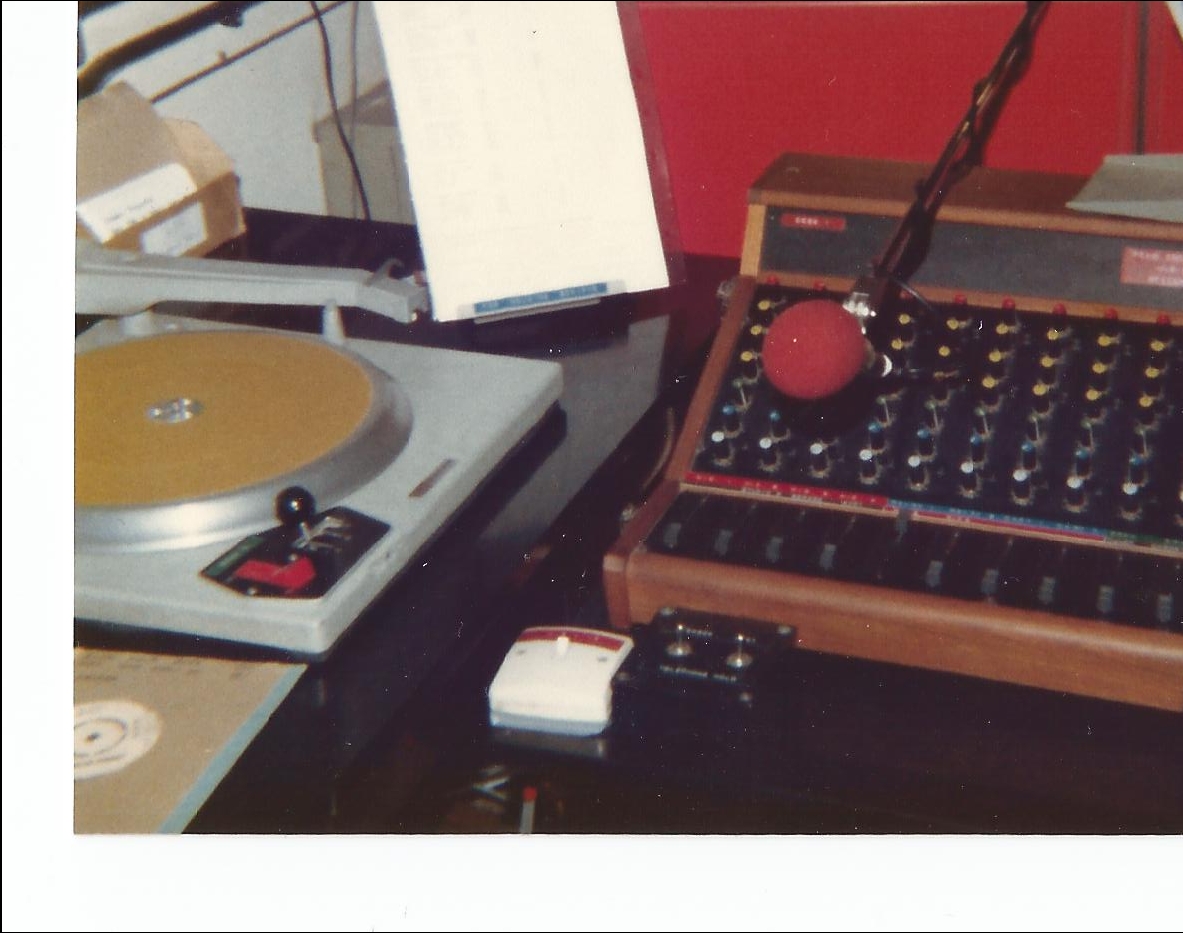
In the studio, our equipment was sufficient.  Sonifex cart machines with a loud click played out our stolen poorly-edited jingles, armed with black AA2 carts, which our younger members dutifully re-laced with lubricated tape.  A few battered Ferrograph tape machines with an editing block nailed near the heads were reserved for editing; and a swish new Revox played out the evening's recorded shows.  Sig tunes for each show, which were compulsory given this was the 70s, were kept on 5" spools. Yellow leader at the front red at the rear. Turntables were slow to start, so each had a felt slip mat which one gripped until the required moment. Release the fingers; and lo, the Dooleys.

Early lessons were learned about the importance of vocabulary.  'Listeners' were referred to as just that on-air, never 'patients'.  The hope was that our pirated jingles and spotty, adolescent presenters playing The Old Rugged Cross meant that they might forget the major surgery the following day. 
Radio Trent feature on NHR 1977

We received a crash course on how radio is a one-to-one medium; not least because, on lucky days, we did indeed amass that single listener. Alas, too many on-air professionally nowadays forget the power of the singular 'you' and suggest that 'any of you  out there' keep your 'texts coming in'. It's a basic rule of radio broken by too many, too often.


Note the light switch (mic live light!)
An early duty for me was the programme for the long-stay geriatric hospitals. One popular feature within was the 'birthday list': "Hello Agnes, happy 93rd birthday. Here's George Formby - and the one entitled...". We'd run down the shiny tiled corridors to conduct a last minute check that all was well with dear Agnes's health just minutes before the show; on the pretext of delivering a branded Christmas card.

The Nottingham  station, run by the towering Barrie 'James' Pierpoint, was strong on PR.  Upon its birthday, a team of typists would compose neat letters on the Golf-ball typewriter to professional stations, requesting 'anniversary greetings'.  May I now concede that it was actually a ruse to get stereo copies of their jingles.  Now, though, those messages have become a lucky piece of radio history.
Friends, it was good to see you again. Including those who should have gone into radio but sadly didn't.  


More hospital radio memories - and other fond recollections - in my book 'Radio Moments'


More hospital radio discussion on blog post:  'Why Do We Bother With Hospital Radio?'

What can radio learn from how it has handled COVID 19?

In times like this, you turn to your friends. And radio is a friend. Day or night, it’s there to pick-you up, to comfort you, to explai...